 Indietro
Physics with Calculus: Newton's Laws and Linear Motion
 04:46
04:46
Termini in questo insieme (20)
Motion that proceeds from the "nature" of an object, depending on its elemental composition. Speed is roughly proportional to weight.
Motion produced by external pushes or pulls. Objects remain at rest unless acted upon by a force.
Objects of different weights fall at the same rate and hit the ground simultaneously if air resistance is negligible.
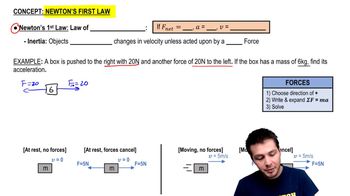
Inertia is a property of matter to resist changes in motion.
Every object continues in a state of rest or uniform motion in a straight line unless acted on by a nonzero net force.
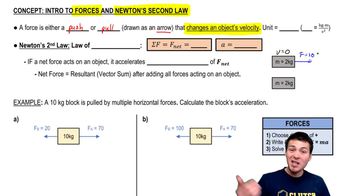
Force (symbol F) is an interaction that changes motion. SI unit is the newton (N).
Vectors have magnitude and direction (e.g., force, velocity). Scalars have only magnitude (e.g., mass, temperature).
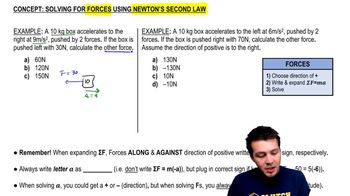
The vector sum of all forces acting on an object.
Subtract the smaller force from the larger force and take the direction of the larger force.
Use the Pythagorean theorem to find the magnitude of the resultant vector.
An object is in equilibrium when the vector sum of all forces equals zero: \(\sum F = 0\).
The force perpendicular to the surface that supports the weight of an object.
Static equilibrium: object at rest. Dynamic equilibrium: object moving at constant speed in a straight line.
Acceleration is the rate of change of velocity over time. Symbol: a. Unit: m/s\(^2\).
Acceleration occurs due to change in direction even if speed is constant.
Acceleration due to gravity is approximately 9.8 m/s\(^2\).
Speed increases by \(gt\), where g is acceleration due to gravity and t is time.
Distance is given by \(\frac{1}{2}gt^2\).
Upward and downward velocities at equal heights are equal in magnitude but opposite in direction.
Motion is always described relative to a reference frame, usually the Earth's surface.