 Indietro
Physics with Calculus - Newton's Laws and Motion Concepts
 04:46
04:46
Termini in questo insieme (24)
Objects have a proper place determined by four elements (earth, water, air, fire) and move straight up or down to reach it; beyond Earth, motion is circular.
Galileo showed that objects of different weights fall at the same rate without air resistance and that a moving object needs no force to keep moving without friction.
Inertia is a property of matter to resist changes in motion and depends on the object's mass.
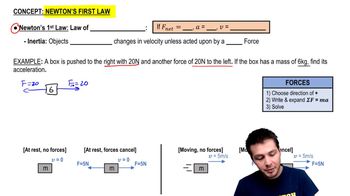
Every object continues in a state of rest or uniform motion in a straight line unless acted on by a nonzero net force.
A quantity described by both magnitude and direction, represented by arrows (e.g., force, velocity, acceleration).
Subtract the smaller force from the larger one; the net force direction is that of the larger force.
The vector sum of all forces acting on a nonaccelerating object equals zero, expressed as \(\sum \vec{F} = 0\).
An upward force exerted by a surface that opposes the force of gravity on an object resting on it.
Static equilibrium is when an object is at rest; dynamic equilibrium is when an object moves at constant speed in a straight line.
Motion is described relative to a reference point; for example, walking on Earth is relative to Earth, but Earth moves relative to the Sun.
Speed is the distance covered per unit time, measured in meters per second (m/s).
Average speed is total distance divided by total time; instantaneous speed is the speed at a specific moment.
Velocity is a vector quantity describing both the speed and direction of an object's motion.
Acceleration is the rate of change of velocity over time, involving changes in speed, direction, or both.
Acceleration = \(\frac{\Delta v}{\Delta t}\), where \(\Delta\) v is change in velocity and \(\Delta\) t is time interval.
Motion under the influence of gravity only, with acceleration approximately \(9.8\,m/s^2\) downward.
Velocity = acceleration × time, or \(v = g t\).
The constant speed reached when air resistance balances the weight of a falling object, resulting in zero net force and no acceleration.
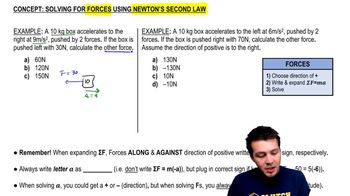
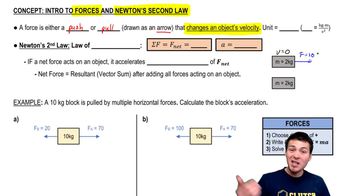
Acceleration of an object is directly proportional to the net force and inversely proportional to its mass, \(\vec{a} = \frac{\vec{F}_{net}}{m}\).
Mass is the amount of matter and measure of inertia; weight is the force due to gravity on that mass.
For every action force, there is an equal and opposite reaction force acting on different objects.
Because they act on different objects, so they do not cancel within a single object’s force balance.
Forces can be resolved into perpendicular components (vertical and horizontal) which add vectorially to give the resultant force.
The normal force decreases as the incline angle increases, becoming zero when the plane is vertical.