 Indietro
Physics with Calculus: Oscillations and Simple Harmonic Motion
 04:07
04:07
Termini in questo insieme (20)
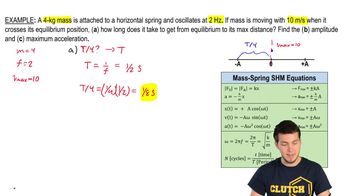
SHM is periodic motion where the restoring force is directly proportional to displacement and acts toward equilibrium, producing oscillations like a mass on a spring.
The restoring force is given by Hooke's Law: \(F_s = -kx\), where k is the spring constant and x is displacement.
\(\omega = \sqrt{\frac{k}{m}}\), where k is the spring constant and m is the mass.
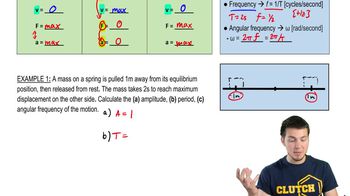
Amplitude (A): max displacement from equilibrium.
Period (T): time for one complete oscillation.
Frequency (f): number of oscillations per second, \(f=\frac{1}{T}\).
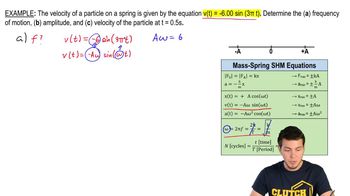
\(x(t) = A \cos(\omega t + \phi)\), where A is amplitude, ω angular frequency, and φ phase constant.
Velocity: \(v(t) = -\omega A \sin(\omega t + \phi)\)
Acceleration: \(a(t) = -\omega^2 A \cos(\omega t + \phi) = -\omega^2 x(t)\)
\(T = 2\pi \sqrt{\frac{L}{g}}\), where L is pendulum length and g is acceleration due to gravity.
For small angles, \(\theta \approx \sin\theta \approx \tan\theta\), simplifying the pendulum's motion to SHM.
\(I = mr^2\), where m is mass and r is distance from pivot.
\(I \frac{d^2 \theta}{dt^2} = -\kappa \theta\), where κ is torsional constant and I moment of inertia.
\(\omega = \sqrt{\frac{\kappa}{I}}\)
\(E = \frac{1}{2}kA^2 = \frac{1}{2}mv_{max}^2\), constant and sum of potential and kinetic energy.
Damping causes amplitude to decrease over time, energy is lost to nonconservative forces, and motion is no longer ideal SHM.
Resonance occurs when the driving frequency matches the system's natural frequency, causing large amplitude oscillations.
\(A = \frac{F_0/m}{\sqrt{(\omega_0^2 - \omega_d^2)^2 + (b\omega_d/m)^2}}\), where F₀ is driving force amplitude, ω₀ natural frequency, ω_d driving frequency, and b damping constant.
\(f = \frac{1}{T}\), frequency is the reciprocal of the period.
φ determines the initial position and velocity of the oscillator at time zero.
The projection of uniform circular motion onto one axis is SHM, with displacement \(x(t) = A \cos(\omega t + \phi)\).
\(\tau = -mgL \sin\theta\), where L is distance from pivot to center of mass.
\(T = 2\pi \sqrt{\frac{I}{mgL}}\), where I is moment of inertia about pivot.