 Indietro
Vectors and Vector Operations in Physics
 06:13
06:13
Termini in questo insieme (20)
A vector is a quantity that has both magnitude and direction, represented by an arrow.
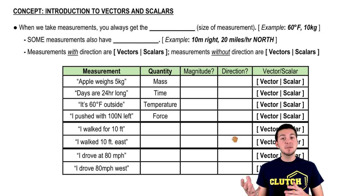
Scalars have only magnitude, while vectors have both magnitude and direction.
The magnitude of a vector 𝐴⃗ is denoted as 𝐴 and equals the length of the arrow, with the same units as the vector.
By an angle 𝜃 relative to the positive x-axis, measured counterclockwise (positive) or clockwise (negative).
𝐴ₓ = 𝐴 cos 𝜃 and 𝐴ᵧ = 𝐴 sin 𝜃, valid in all four quadrants.
Use the Pythagorean theorem: \(A=\sqrt{A_x^2 + A_y^2}\).
Use the inverse tangent: \(\theta=\arctan\left(\frac{A_y}{A_x}\right)\), adjusting for quadrant.
Place the tail of one vector at the tip of another; the resultant vector goes from the tail of the first to the tip of the second.
Yes, 𝐴⃗ + 𝐵⃗ = 𝐵⃗ + 𝐴⃗.
𝐴⃗ - 𝐵⃗ = 𝐴⃗ + (-𝐵⃗), where -𝐵⃗ is the vector with the same magnitude but opposite direction as 𝐵⃗.
Add all x-components and y-components separately, then find magnitude and direction of the resultant vector.
As 𝐴⃗ = A_x 𝚤̂ + A_y 𝚥̂ + A_z 𝑘̂, with components along x, y, and z axes.
Use \(A=\sqrt{A_x^2 + A_y^2 + A_z^2}\).
𝑎⃗ ⋅ 𝑏⃗ = a_x b_x + a_y b_y + a_z b_z, resulting in a scalar.
\(\cos \theta = \frac{\mathbf{a} \cdot \mathbf{b}}{ab}\), where 𝜃 is the angle between vectors.
Zero if vectors are perpendicular, positive if angle < 90°, negative if angle > 90°.
𝑐⃗ = 𝑎⃗ × 𝑏⃗ is a vector perpendicular to both 𝑎⃗ and 𝑏⃗, with magnitude \(c = ab \sin \theta\).
It equals the area of the parallelogram spanned by the two vectors.
When the two vectors are parallel or anti-parallel (angle 0° or 180°).
It is anticommutative: 𝑎⃗ × 𝑏⃗ = - 𝑏⃗ × 𝑎⃗, and distributes over addition.