 Indietro
Motion Along a Straight Line (1D Kinematics): Study Notes
Guida di studio - Note intelligenti
 Appunti personalizzati basati sui tuoi materiali, ampliati con definizioni chiave, esempi e contesto.
Motion Along a Straight Line (1D Kinematics)
Introduction to Kinematics
Kinematics is the branch of physics that describes the motion of objects without considering the causes of motion. In one-dimensional motion, we focus on how position, velocity, and acceleration change with time along a straight line.
Displacement is a vector quantity representing the change in position from one point to another.
Velocity and acceleration are also vectors, meaning they have both magnitude and direction.
Understanding the difference between distance (a scalar) and displacement (a vector) is crucial.
Displacement, Time, and Velocity
Displacement is defined as the change in position, and velocity describes how quickly and in what direction displacement occurs.
Displacement:
Elapsed Time:
Average Velocity:
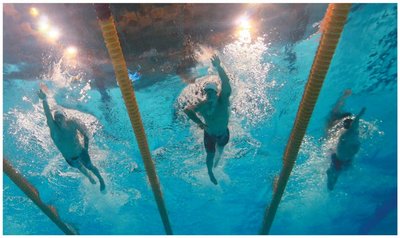
The winner in a straight-line race is the one with the greatest magnitude of average velocity.

Position-Time Graphs and Velocity
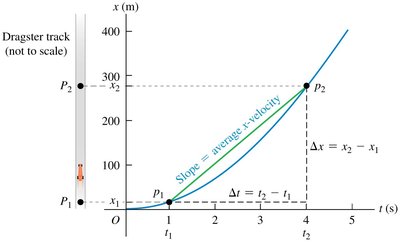
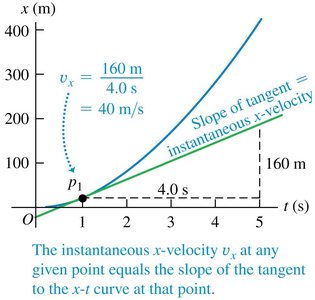
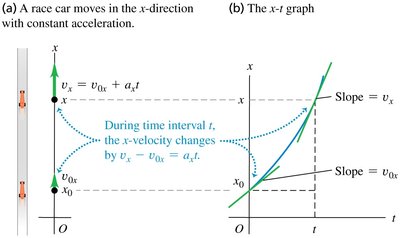
Position-time (x-t) graphs are essential tools for visualizing motion. The slope of the line on an x-t graph represents velocity.
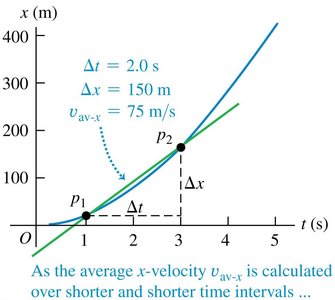
Average velocity is the slope of the secant line between two points.
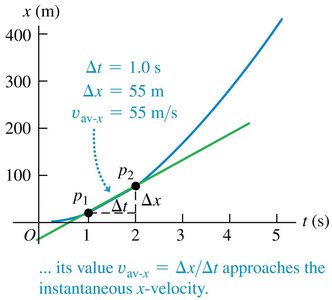
As the time interval gets smaller, the average velocity approaches the instantaneous velocity.
Instantaneous Velocity
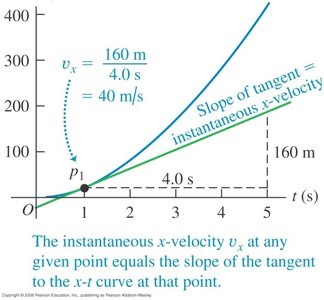
The instantaneous velocity at a specific time is the slope of the tangent to the x-t curve at that point. It is mathematically defined as the derivative of position with respect to time.
Instantaneous Velocity:
Instantaneous velocity can be found by differentiating the position function with respect to time.

Velocity and Acceleration
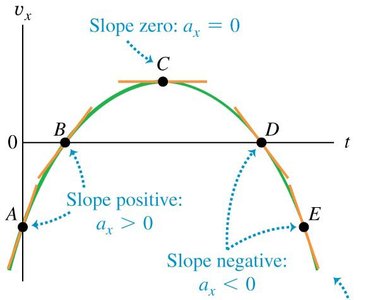
Acceleration describes how velocity changes with time. Like velocity, acceleration can be average or instantaneous.
Average Acceleration:
Instantaneous Acceleration:
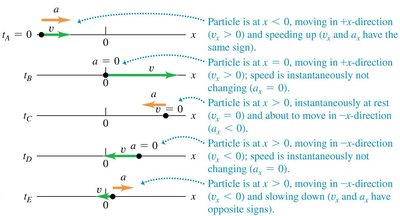
Acceleration is positive when velocity increases in the positive direction and negative when velocity decreases or increases in the negative direction.
Motion with Constant Acceleration
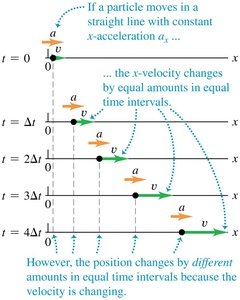
Many problems in introductory physics involve motion with constant acceleration, such as free fall or cars accelerating uniformly. In these cases, the following equations of motion apply:
Freely Falling Bodies
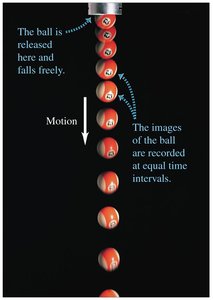
Free fall is a special case of motion with constant acceleration, where the only force acting is gravity. The acceleration due to gravity is downward.
All objects in free fall near Earth's surface experience the same acceleration, regardless of mass.
Position and velocity equations for free fall are the same as for constant acceleration, with replaced by (if upward is positive).
Non-Constant Acceleration and Integration
When acceleration is not constant, the equations of motion must be derived using calculus. The velocity and position are found by integrating acceleration and velocity, respectively.
Velocity from Acceleration:
Position from Velocity:
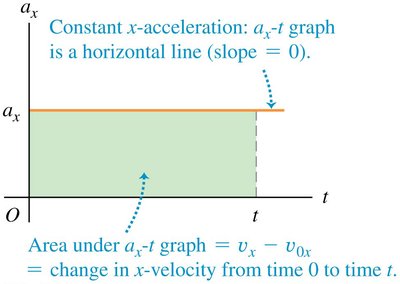
The area under the acceleration-time graph gives the change in velocity.
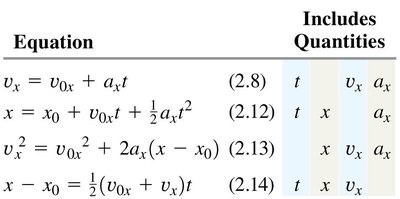
Summary Table: Equations of Motion with Constant Acceleration
Equation | Includes Quantities |
|---|---|
, , | |
, , | |
, , | |
, , |
Additional info: In all calculations, it is important to keep track of units and to solve symbolically before substituting numerical values. The concepts of average and instantaneous quantities are foundational for later topics in physics, including dynamics and energy.
