 Indietro
Ray Optics: The Ray Model of Light, Reflection, and Refraction
Guida di studio - Note intelligenti
 Appunti personalizzati basati sui tuoi materiali, ampliati con definizioni chiave, esempi e contesto.
Chapter 18: Ray Optics
Introduction to Ray Optics
Ray optics, also known as geometric optics, is a model of light that describes the propagation of light as straight lines called rays. This model is valid when the objects and apertures involved are much larger than the wavelength of light, so diffraction effects can be ignored. Ray optics is essential for understanding phenomena such as reflection, refraction, and image formation by mirrors and lenses.
The Ray Model of Light
Definition and Properties of Light Rays
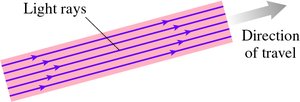
Light ray: An idealized line that shows the direction in which light energy is traveling.
Light rays travel in straight lines through a vacuum or transparent material.
The speed of light in a material is given by: where is the speed of light in vacuum and is the index of refraction of the material.
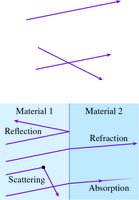
Light rays can cross without interacting with each other.
Light rays continue indefinitely unless they interact with matter (reflection, refraction, scattering, or absorption).
Sources of Light Rays
Self-luminous objects: Objects that emit their own light (e.g., the sun, lightbulbs).
Reflective objects: Objects that reflect light from other sources (e.g., paper, trees).
Types of sources:
Ray source: Approximated by a laser beam.
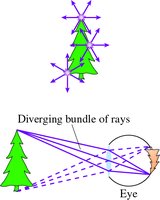
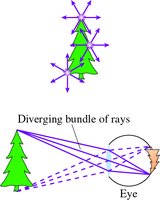
Point source: Emits light in all directions from a single point.
Extended source: Every point on the surface emits light (e.g., the sun, a flame).
Parallel-ray source: Produces nearly parallel rays (e.g., distant stars, flashlights).
Ray Diagrams and Visibility
Ray diagrams simplify complex situations by showing only a few representative rays.
To see an object, rays from the object must enter the eye and be focused on the retina.
Point and extended sources are visible from any direction, while a single ray (like a laser) is only visible if it enters the eye.
Reflection of Light
Types of Reflection
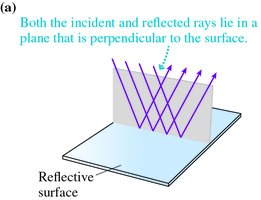
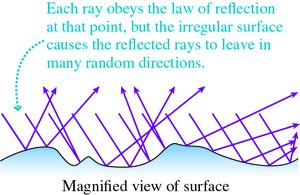
Specular reflection: Reflection from a smooth, shiny surface (e.g., mirrors, polished metal).
Diffuse reflection: Reflection from a rough surface, causing rays to scatter in many directions.
The Law of Reflection
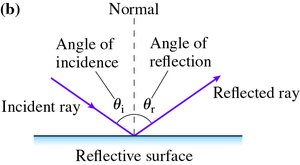
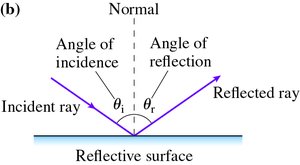
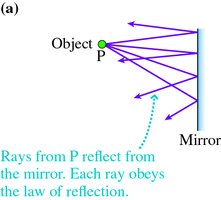
The incident ray, the reflected ray, and the normal (perpendicular to the surface) all lie in the same plane.
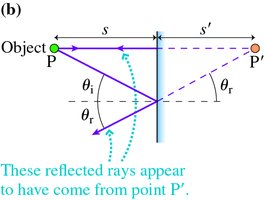
The angle of incidence () equals the angle of reflection ():
Angles are always measured from the normal to the surface.
Plane Mirrors and Image Formation
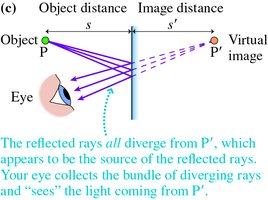
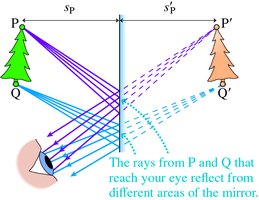
A plane mirror is a flat mirror that forms images by reflection.
Rays from a point on the object reflect according to the law of reflection and appear to diverge from a point behind the mirror (the virtual image).
The image distance () is equal to the object distance ():
Virtual images cannot be projected onto a screen because no light actually passes through the image location.
Refraction of Light
Definition and Snell's Law
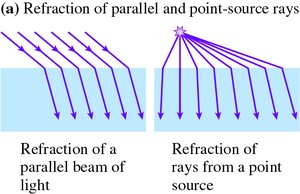
Refraction: The bending of light as it passes from one medium to another with a different index of refraction.
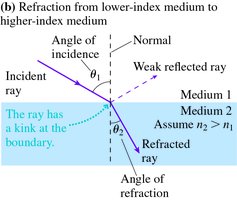
When light enters a medium with a higher index of refraction, it bends toward the normal; when entering a lower index, it bends away from the normal.
Snell's Law: where and are the indices of refraction, and and are the angles with respect to the normal.
Analyzing Refraction
Draw a ray diagram with the incident and refracted rays.
Draw the normal at the boundary and measure all angles from it.
Use Snell's law to solve for unknown angles or indices.
Total Internal Reflection (TIR)
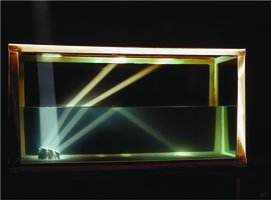
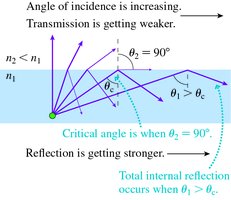
Occurs when light attempts to move from a medium with higher index () to lower index () at an angle greater than the critical angle ().
At the critical angle, the refracted ray travels along the boundary ().
For , all light is reflected back into the original medium.
The critical angle is given by:
Applications: Fiber Optics
Optical fibers use total internal reflection to transmit light over long distances with minimal loss.
A glass core is surrounded by cladding with a lower index of refraction, ensuring TIR at the core-cladding boundary.
Used in telecommunications and medical instruments (e.g., endoscopes).
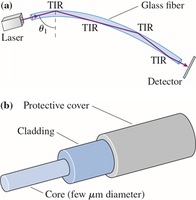
Image Formation by Refraction
Apparent Depth and Image Location
Objects submerged in a medium (e.g., water) appear closer to the surface due to refraction at the boundary.
The apparent depth () is related to the real depth () by: where is the index of the medium containing the object, and is the index of the observer's medium.
This effect explains why objects under water appear shallower than they actually are.
Summary Table: Types of Light Interactions at Boundaries
Interaction | Description |
|---|---|
Reflection | Bouncing of light from a surface |
Refraction | Bending of light as it passes into a new medium |
Scattering | Light is redirected in many directions by small particles |
Absorption | Light energy is absorbed and converted to other forms |
Key Equations
Speed of light in a medium:
Law of reflection:
Snell's Law:
Critical angle for TIR:
Apparent depth:
Examples and Applications
Calculating the streak of reflected light on the floor using the law of reflection.
Determining the index of refraction of a prism using Snell's law.
Finding the diameter of the visible circle on water's surface due to total internal reflection.
Explaining why objects under water appear closer than they are.
Additional info: These notes provide a comprehensive overview of the ray model of light, including the fundamental laws of reflection and refraction, and their applications in everyday phenomena and technology.
