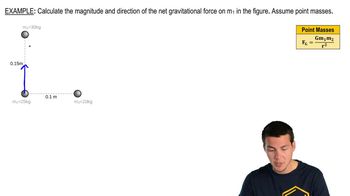
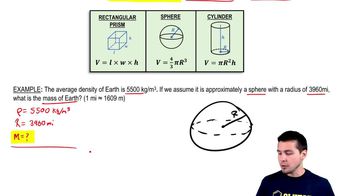
The speed v of an object is given by the equation v = At³ ― Bt, where t refers to time. What are the SI units for the constants A and B?
Ch. 01 - Introduction, Measurement, Estimating
Giancoli Douglas5th editionPhysics for Scientists and EngineersISBN: 9780137488179Non è quello che usi tu?Cambia libro di testo
Tutti i libri di testo
Giancoli Douglas 5th edition
Ch. 01 - Introduction, Measurement, Estimating
Problema 6.80b
Giancoli Douglas 5th edition
Ch. 01 - Introduction, Measurement, Estimating
Problema 6.80bCapitolo 1, Problema 6.80b
A plumb bob (a mass m hanging on a string) is deflected from the vertical by an angle θ due to a massive mountain nearby (Fig. 6–37).
(b) Make a rough estimate of the mass of Mt. Everest, assuming it has the shape of a cone 4000 m high and base of diameter 4000 m. Assume its mass per unit volume is 3000kg per m³.
<IMAGE>
Guida verificata passo dopo passo1
Calculate the volume of Mt. Everest assuming it is a cone. Use the formula for the volume of a cone, which is V = \(\frac{1}{3}\) \(\pi\) r^2 h, where r is the radius of the base and h is the height of the cone. Given that the diameter of the base is 4000 m, the radius r will be half of the diameter.
Substitute the values into the volume formula. Here, r = 2000 m (half of 4000 m) and h = 4000 m.
Calculate the mass of Mt. Everest using the density formula, which is Mass = Density \(\times\) Volume. The problem states that the mass per unit volume (density) of the mountain is 3000 kg/m³.
Substitute the calculated volume and the given density into the mass formula to estimate the mass of Mt. Everest.
Reflect on the assumptions made in this calculation, such as the shape of the mountain being a perfect cone and the uniform density, and consider how these might affect the accuracy of the estimate.

Risposta video verificata per un problema simile:
Questa soluzione video è stata consigliata dai nostri tutor come utile per risolvere questo problema.
Durata del video:
8mConcetti chiave
Ecco i concetti essenziali che devi comprendere per rispondere correttamente alla domanda.
Gravitational Force
Gravitational force is the attractive force between two masses, described by Newton's law of universal gravitation. It states that every point mass attracts every other point mass with a force that is directly proportional to the product of their masses and inversely proportional to the square of the distance between their centers. This concept is crucial for understanding how the mass of Mt. Everest affects the plumb bob's deflection.
Video consigliato:
Percorso guidato
Gravitational Forces in 2D
Volume and Density
Volume is the amount of space an object occupies, while density is the mass per unit volume of a substance. To estimate the mass of Mt. Everest, we can calculate its volume assuming a conical shape and then multiply by its density. This relationship is essential for determining the mountain's mass based on its dimensions and material properties.
Video consigliato:
Percorso guidato
Problems with Mass, Volume, & Density
Trigonometry in Physics
Trigonometry is a branch of mathematics that deals with the relationships between the angles and sides of triangles. In this context, it helps analyze the angle θ at which the plumb bob is deflected due to the gravitational influence of Mt. Everest. Understanding trigonometric functions is vital for relating the angle of deflection to the forces acting on the bob.
Video consigliato:
Percorso guidato
Trigonometry
Pratica correlata
Domanda del libro di testo
2083
views
Domanda del libro di testo
How many significant figures does the following number have? 8700
1231
views
Domanda del libro di testo
American football uses a field that is 100.0 yd long, whereas a soccer field is 100.0 m long. Which field is longer, and by how much (give yards, meters, and percent)?
1511
views
Domanda del libro di testo
How many significant figures does the following number have? 0.0086
1987
views
Domanda del libro di testo
Many sailboats are docked at a marina 4.4 km away on the opposite side of a lake. You stare at one of the sailboats because, when you are lying flat at the water's edge, you can just see its deck but none of the side of the sailboat. You then go to that sailboat on the other side of the lake and measure that the deck is 1.5 m above the level of the water. Using Fig. 1–14, where h = 1.5 m , estimate the radius R of the Earth.
1392
views