Ch. 04 - Dynamics: Newton's Laws of Motion
Giancoli Douglas - Physics for Scientists and Engineers 5th edition
Giancoli Douglas5th editionPhysics for Scientists and EngineersISBN: 9780137488179Non è quello che usi tu?Cambia libro di testo
Capitolo 4, Problema 43b

A 27-kg chandelier hangs from a ceiling on a vertical 3.4-m-long wire. What will be the tension in the wire?

Guida verificata passo dopo passo
1
Identify the forces acting on the chandelier. Since it is hanging at rest, the forces are in equilibrium. The two forces are the gravitational force (weight of the chandelier) acting downward and the tension in the wire acting upward.
Calculate the gravitational force acting on the chandelier using the formula: Fg=mg, where m is the mass of the chandelier (27 kg) and g is the acceleration due to gravity (approximately 9.8 m/s²).
Substitute the given values into the formula: Fg=27×9.8. This will give the gravitational force in newtons.
Since the chandelier is in equilibrium (not accelerating), the tension in the wire must exactly balance the gravitational force. Therefore, the tension in the wire is equal to the gravitational force: T=Fg.
Conclude that the tension in the wire is numerically equal to the gravitational force calculated in step 3. Ensure the units are in newtons (N).

Risposta video verificata per un problema simile:

Questa soluzione video è stata consigliata dai nostri tutor come utile per risolvere questo problema.

Concetti chiave

Ecco i concetti essenziali che devi comprendere per rispondere correttamente alla domanda.

Tension in a Wire

Tension is the force exerted along a wire or rope when it is pulled tight by forces acting from opposite ends. In the case of a chandelier hanging from a wire, the tension must counteract the weight of the chandelier to maintain equilibrium. The tension can be calculated using the formula T = mg, where m is the mass and g is the acceleration due to gravity.
Video consigliato:
Percorso guidato
09:57
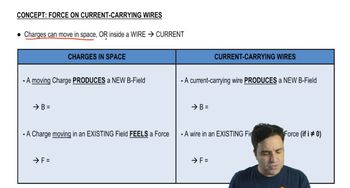
Magnetic Force on Current-Carrying Wire

Weight

Weight is the force exerted by gravity on an object, calculated as the product of its mass and the acceleration due to gravity (W = mg). For the chandelier, its weight is the force that the tension in the wire must balance. Understanding weight is crucial for determining the tension in the wire supporting the chandelier.
Video consigliato:
Percorso guidato
10:19
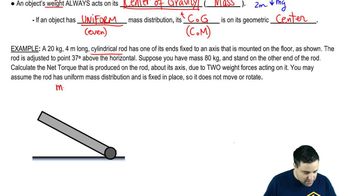
Torque Due to Weight

Equilibrium

Equilibrium occurs when all the forces acting on an object are balanced, resulting in a state of rest or constant motion. In this scenario, the chandelier is in static equilibrium, meaning the upward tension in the wire equals the downward gravitational force (weight) acting on it. This principle is fundamental in analyzing forces in static systems.
Video consigliato:
Percorso guidato
10:13
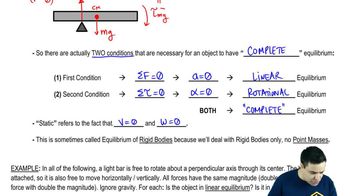
Torque & Equilibrium
Pratica correlata
Domanda del libro di testo

An object is hanging by a string from your rearview mirror. While you are accelerating at a constant rate from rest to 28 m/s in 5.0 s, what angle θ does the string make with the vertical? See Fig. 4–46.

1487
views
1
rank

Domanda del libro di testo

At the instant a race began, a 65-kg sprinter exerted a force of 720 N on the starting block at a 22° angle with respect to the ground. What was the horizontal acceleration of the sprinter?

1376
views
Domanda del libro di testo

At the instant a race began, a 65-kg sprinter exerted a force of 720 N on the starting block at a 22° angle with respect to the ground. If the force was exerted for 0.32 s, with what speed did the sprinter leave the starting block?

1143
views
Domanda del libro di testo

A 27-kg chandelier hangs from a ceiling on a vertical 3.4-m-long wire. What horizontal force would be necessary to displace its position 0.15 m to one side?

1391
views
Domanda del libro di testo

Determine a formula for the acceleration of the system shown in Fig. 4–49 (see Problem 55) if the cord has a non-negligible mass mC. Specify in terms of ℓA and ℓB , the lengths of cord from the respective masses to the pulley. (The total cord length is ℓA + ℓB.)

1411
views
Domanda del libro di testo

As shown in Fig. 4–48, five balls (masses 2.00, 2.05, 2.10, 2.15, 2.20 kg) hang from a crossbar. Each mass is supported by '5-lb test' fishing line which will break when its tension force exceeds 22.2 N (5.00lb). When this device is placed in an elevator, which accelerates upward, only the lines attached to the 2.05 and 2.00 kg masses do not break. Within what range is the elevator's acceleration?

1294
views