Ch. 04 - Dynamics: Newton's Laws of Motion
Giancoli Douglas - Physics for Scientists and Engineers 5th edition
Giancoli Douglas5th editionPhysics for Scientists and EngineersISBN: 9780137488179Non è quello che usi tu?Cambia libro di testo
Capitolo 4, Problema 6

According to a simplified model of a mammalian heart, at each pulse approximately 20 g of blood is accelerated from 0.25 m/s to 0.35 m/s during a period of 0.10 s. What is the magnitude of the force exerted by the heart muscle?

Guida verificata passo dopo passo
1
Identify the given values: mass of the blood (m) = 20 g = 0.020 kg (convert grams to kilograms), initial velocity (v₁) = 0.25 m/s, final velocity (v₂) = 0.35 m/s, and time interval (Δt) = 0.10 s.
Calculate the change in velocity (Δv) using the formula: Δv = v₂ - v₁. Substitute the given values to find the change in velocity.
Determine the acceleration (a) using the formula: a = Δv / Δt. Substitute the values of Δv and Δt to calculate the acceleration.
Use Newton's second law of motion, F = m * a, to calculate the force exerted by the heart. Substitute the values of mass (m) and acceleration (a) into the formula.
Simplify the expression to find the magnitude of the force exerted by the heart muscle.

Risposta video verificata per un problema simile:

Questa soluzione video è stata consigliata dai nostri tutor come utile per risolvere questo problema.

Concetti chiave

Ecco i concetti essenziali che devi comprendere per rispondere correttamente alla domanda.

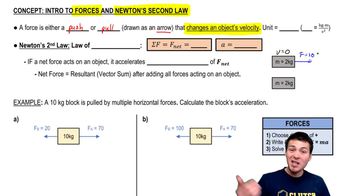
Newton's Second Law of Motion

Newton's Second Law states that the force acting on an object is equal to the mass of the object multiplied by its acceleration (F = ma). In this context, the heart's force can be calculated by determining the acceleration of the blood and multiplying it by the mass of the blood being accelerated.
Video consigliato:
Percorso guidato
06:54
Intro to Forces & Newton's Second Law

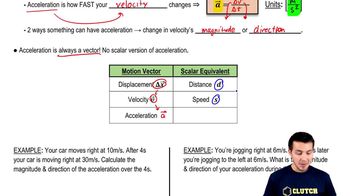
Acceleration

Acceleration is the rate of change of velocity of an object over time. It can be calculated by taking the difference between the final and initial velocities and dividing by the time taken for that change. In this case, the acceleration of the blood can be found by using the velocities of 0.25 m/s and 0.35 m/s over the time period of 0.10 s.
Video consigliato:
Percorso guidato
05:47
Intro to Acceleration

Mass

Mass is a measure of the amount of matter in an object, typically measured in kilograms or grams. In this problem, the mass of the blood being accelerated is given as 20 g. It is important to convert this mass into kilograms (0.02 kg) when applying it in calculations involving force, as the standard unit of mass in physics is the kilogram.
Video consigliato:
Percorso guidato
20:32
Mass Spectrometers