
Ch. 04 - Dynamics: Newton's Laws of Motion
Giancoli Douglas - Physics for Scientists and Engineers 5th edition
Giancoli Douglas5th editionPhysics for Scientists and EngineersISBN: 9780137488179Non è quello che usi tu?Cambia libro di testo
Capitolo 4, Problema 86

Three mountain climbers who are roped together in a line are ascending an icefield inclined at 29° to the horizontal (Fig. 4–67). The last climber slips, pulling the second climber off his feet. The first climber is able to hold them both. If each climber has a mass of 75 kg, calculate the tension in each of the two sections of rope between the three climbers. Ignore friction between the ice and the fallen climbers.
<IMAGE>

Guida verificata passo dopo passo
1
Identify the forces acting on each climber. For each climber, the forces include their weight (gravitational force), the tension in the rope, and the normal force from the ice surface. Since the ice is frictionless, there is no frictional force to consider.
Break the forces into components parallel and perpendicular to the incline. The weight of each climber can be expressed as \( F_g = m \cdot g \), where \( m \) is the mass of the climber and \( g \) is the acceleration due to gravity. The component of the weight parallel to the incline is \( F_{g, \text{parallel}} = m \cdot g \cdot \sin(\theta) \), and the component perpendicular to the incline is \( F_{g, \text{perpendicular}} = m \cdot g \cdot \cos(\theta) \).
Analyze the forces acting on the last climber (Climber 3). The tension in the rope connecting Climber 3 to Climber 2 must balance the parallel component of Climber 3's weight. Thus, \( T_2 = m \cdot g \cdot \sin(\theta) \).
Analyze the forces acting on the second climber (Climber 2). Climber 2 is being pulled by Climber 3's weight and is also pulling Climber 1. The tension in the rope connecting Climber 2 to Climber 1 must balance the combined parallel components of the weights of Climbers 2 and 3. Thus, \( T_1 = 2 \cdot m \cdot g \cdot \sin(\theta) \).
Substitute the known values into the equations. Use \( m = 75 \ \text{kg} \), \( g = 9.8 \ \text{m/s}^2 \), and \( \theta = 29^\circ \) to calculate the tensions \( T_1 \) and \( T_2 \). Ensure that the trigonometric functions are applied correctly to find the numerical values of the tensions.

Risposta video verificata per un problema simile:

Questa soluzione video è stata consigliata dai nostri tutor come utile per risolvere questo problema.
Durata del video:
10m

Concetti chiave

Ecco i concetti essenziali che devi comprendere per rispondere correttamente alla domanda.

Forces and Tension

In this scenario, the tension in the ropes connecting the climbers is a result of the gravitational force acting on the climbers and the forces exerted by the climbers on each other. Tension is the force transmitted through the rope when it is pulled tight by forces acting from opposite ends. Understanding how to calculate tension involves analyzing the forces acting on each climber and applying Newton's second law.
Video consigliato:
Percorso guidato
06:48
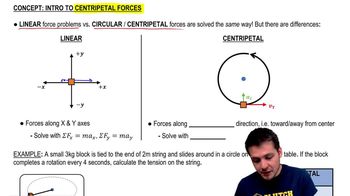
Intro to Centripetal Forces

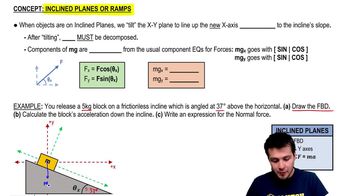
Inclined Plane Dynamics

The icefield's incline at 29° introduces a component of gravitational force acting parallel to the slope, which affects the climbers' ability to remain stationary. The gravitational force can be resolved into two components: one acting perpendicular to the incline and the other parallel to it. This concept is crucial for determining how much force is needed to hold the climbers in place and how it influences the tension in the ropes.
Video consigliato:
Percorso guidato
06:59
Intro to Inclined Planes

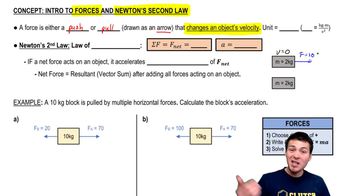
Newton's Second Law of Motion

Newton's second law states that the acceleration of an object is directly proportional to the net force acting on it and inversely proportional to its mass (F = ma). In this problem, it is essential to apply this law to each climber to analyze the forces acting on them when one slips. By setting up equations based on the forces and the mass of the climbers, we can solve for the tension in the ropes.
Video consigliato:
Percorso guidato
06:54
Intro to Forces & Newton's Second Law