
Ch. 05 - Using Newton's Laws: Friction, Circular Motion, Drag Forces
Giancoli Douglas - Physics for Scientists and Engineers 5th edition
Giancoli Douglas5th editionPhysics for Scientists and EngineersISBN: 9780137488179Non è quello che usi tu?Cambia libro di testo
Capitolo 5, Problema 33d

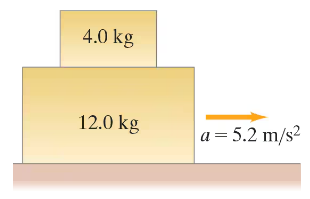
(III) A 4.0-kg block is stacked on top of a 12.0-kg block, which is accelerating along a horizontal table at a = 5.2m/s2 (Fig. 5–43). Let μk = μs = μ. What is the force that must be applied to the 12.0-kg block in (a) and in (b), assuming that the table is frictionless?

Guida verificata passo dopo passo
1
Identify the forces acting on the system. The 4.0-kg block experiences a normal force from the 12.0-kg block and a gravitational force downward. The 12.0-kg block experiences a normal force from the table, a gravitational force downward, and the applied force that causes the acceleration.
Determine the total mass of the system. Since the 4.0-kg block is stacked on the 12.0-kg block, the total mass is the sum of their masses: m_total = m₁ + m₂ = 4.0 kg + 12.0 kg.
Use Newton's second law to calculate the net force required to accelerate the system. The net force is given by F_net = m_total * a, where a is the acceleration of the system (5.2 m/s²).
Since the table is frictionless, the applied force (F_applied) must equal the net force calculated in the previous step. This is because there are no opposing frictional forces acting on the 12.0-kg block.
Express the applied force mathematically as F_applied = (m₁ + m₂) * a. Substitute the given values for m₁, m₂, and a to find the magnitude of the applied force.

Risposta video verificata per un problema simile:

Questa soluzione video è stata consigliata dai nostri tutor come utile per risolvere questo problema.
Durata del video:
10m

Concetti chiave

Ecco i concetti essenziali che devi comprendere per rispondere correttamente alla domanda.

Newton's Second Law of Motion

Newton's Second Law states that the acceleration of an object is directly proportional to the net force acting on it and inversely proportional to its mass. This relationship is expressed by the formula F = ma, where F is the net force, m is the mass, and a is the acceleration. Understanding this law is crucial for calculating the force required to accelerate the blocks in the given scenario.
Video consigliato:
Percorso guidato
06:54
Intro to Forces & Newton's Second Law

Friction

Friction is the force that opposes the relative motion of two surfaces in contact. In this problem, the friction coefficients (μₖ for kinetic and μₛ for static) are given as equal, indicating that the frictional force will play a role if the blocks were on a surface with friction. However, since the table is specified as frictionless, this simplifies the calculations as frictional forces can be ignored.
Video consigliato:
Percorso guidato
08:11
Static Friction & Equilibrium

Free Body Diagram

A Free Body Diagram (FBD) is a graphical representation used to visualize the forces acting on an object. In this scenario, drawing an FBD for the 12.0-kg block will help identify the forces acting on it, including the applied force and the weight of the block. This visual tool is essential for systematically applying Newton's laws to solve for the required applied force.
Video consigliato:
Percorso guidato
08:42
Free-Body Diagrams
Pratica correlata
Domanda del libro di testo

On an ice rink two skaters of equal mass grab hands and spin in a mutual circle once every 2.5 s. If we assume their arms are each 0.80 m long and their individual masses are 55.0 kg, how hard are they pulling on one another?

1331
views
Domanda del libro di testo

Two blocks made of different materials connected together by a thin cord slide down a ramp inclined at an angle θ to the horizontal, Fig. 5–40 (block B is above block A). The masses of the blocks are mA and mB, and the coefficients of friction are μA and μB. If mA = mB=4.0kg, and μA = 0.20 and μB = 0.30, determine the acceleration of the blocks.

735
views
Domanda del libro di testo

Tarzan plans to cross a gorge by swinging in an arc from a hanging vine (Fig. 5–50). If his arms are capable of exerting a force of 1350 N on the vine, what is the maximum speed he can tolerate at the lowest point of his swing? His mass is 78 kg and the vine is 4.8 m long.

1412
views
Domanda del libro di testo

A jet plane traveling 1890 km/h (525 m/s) pulls out of a dive by moving in an arc of radius 4.80 km. What is the plane's acceleration in g's?

1570
views
Domanda del libro di testo

A flatbed truck is carrying a heavy crate. The coefficient of static friction between the crate and the bed of the truck is 0.75. What is the maximum rate at which the driver can decelerate and still avoid having the crate slide against the cab of the truck?

1445
views
Domanda del libro di testo

Two blocks made of different materials connected together by a thin cord slide down a ramp inclined at an angle θ to the horizontal, Fig. 5–40 (block B is above block A). The masses of the blocks are mA and mB, and the coefficients of friction are μA and μB. If mA = mB = 4.0kg, and μA = 0.20 and μB = 0.30, determine the tension in the cord, for an angle θ = 32°.

566
views