Ch. 08 - Conservation of Energy
Giancoli Douglas - Physics for Scientists and Engineers 5th edition
Giancoli Douglas5th editionPhysics for Scientists and EngineersISBN: 9780137488179Non è quello che usi tu?Cambia libro di testo
Capitolo 8, Problema 7

A particle is constrained to move in one dimension along the x axis and is acted upon by a force given by F→(x)\(\overrightarrow{F}\)\(\left\)(x\(\right\)) = - (k/x³) î, where k is a constant with units appropriate to the SI system. Find the potential energy function U(x), if U is arbitrarily defined to be zero at x = 2.0m, so that U (2.0m) = 0.

Guida verificata passo dopo passo
1
The relationship between force and potential energy is given by the formula: F(x)=-dU(x)/dx. This means the force is the negative derivative of the potential energy with respect to position.
Rearrange the formula to express the potential energy in terms of the force: U(x)=-∫x∞F(x)dx. Here, the integral is taken from a reference point to the position x.
Substitute the given force F(x)=-kx3 into the integral: U(x)=-∫2.0x-kx3dx. Note that the reference point is given as x=2.0 where U(2.0)=0.
Evaluate the integral: -∫2.0x-kx3dx=-[-k2x2]|2.0tox. Simplify the result to express U(x).
Finally, apply the boundary condition U(2.0)=0 to determine the constant of integration, ensuring the potential energy function satisfies the given condition. This will yield the final expression for U(x).

Risposta video verificata per un problema simile:

Questa soluzione video è stata consigliata dai nostri tutor come utile per risolvere questo problema.
Durata del video:
4m

Concetti chiave

Ecco i concetti essenziali che devi comprendere per rispondere correttamente alla domanda.

Force and Potential Energy Relationship

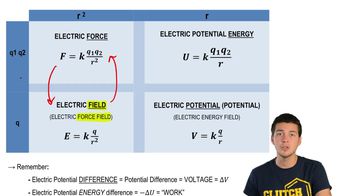
In physics, the relationship between force and potential energy is fundamental. The force acting on a particle can be derived from the potential energy function, where the force is the negative gradient of potential energy. Mathematically, this is expressed as F(x) = -dU/dx. Understanding this relationship allows us to find the potential energy associated with a given force.
Video consigliato:
Percorso guidato
03:43
Relationships Between Force, Field, Energy, Potential

Integration in Physics

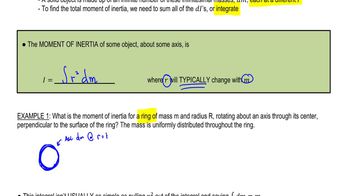
Integration is a mathematical process used to find the total accumulation of a quantity, such as area under a curve. In the context of finding potential energy from force, we integrate the force function with respect to position. This process is essential for determining the potential energy function U(x) from the given force F(x), as it allows us to calculate how energy changes with position.
Video consigliato:
Percorso guidato
11:43
Finding Moment Of Inertia By Integrating

Boundary Conditions in Potential Energy

Boundary conditions are specific values that define the behavior of a function at certain points. In this problem, the potential energy U is defined to be zero at x = 2.0 m. This condition is crucial for determining the constant of integration when calculating U(x), ensuring that the potential energy function aligns with the physical scenario described in the problem.
Video consigliato:
Percorso guidato
07:24
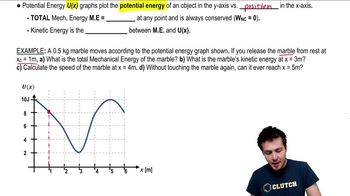
Potential Energy Graphs