Ch. 08 - Conservation of Energy
Giancoli Douglas - Physics for Scientists and Engineers 5th edition
Giancoli Douglas5th editionPhysics for Scientists and EngineersISBN: 9780137488179Non è quello che usi tu?Cambia libro di testo
Capitolo 8, Problema 44b

Determine the escape velocity from the Sun for an object at the average distance of the Earth (1.50 x 10⁸ km). Compare (give factor for each) to the speed of the Earth in its orbit.

Guida verificata passo dopo passo
1
Step 1: Recall the formula for escape velocity, which is derived from the conservation of energy. The escape velocity \( v_{e} \) is given by \( v_{e} = \sqrt{\frac{2GM}{r}} \), where \( G \) is the gravitational constant \( 6.674 \times 10^{-11} \ \text{m}^3\text{kg}^{-1}\text{s}^{-2} \), \( M \) is the mass of the Sun (\( 1.989 \times 10^{30} \ \text{kg} \)), and \( r \) is the distance from the Sun (\( 1.50 \times 10^{11} \ \text{m} \), converted from kilometers).
Step 2: Substitute the known values into the escape velocity formula. This involves plugging in \( G \), \( M \), and \( r \) into \( v_{e} = \sqrt{\frac{2GM}{r}} \). Ensure all units are consistent (e.g., meters, kilograms, seconds).
Step 3: To compare the escape velocity to the Earth's orbital speed, recall the formula for orbital speed \( v_{o} \), which is \( v_{o} = \sqrt{\frac{GM}{r}} \). Notice that the escape velocity is related to the orbital speed by \( v_{e} = \sqrt{2} \cdot v_{o} \).
Step 4: Calculate the factor by which the escape velocity exceeds the Earth's orbital speed. Using the relationship \( v_{e} = \sqrt{2} \cdot v_{o} \), the factor is simply \( \sqrt{2} \), which is approximately 1.414.
Step 5: Conclude that the escape velocity from the Sun at Earth's average distance is approximately 1.414 times the Earth's orbital speed. This relationship is a direct consequence of the mathematical connection between escape velocity and orbital speed.

Risposta video verificata per un problema simile:

Questa soluzione video è stata consigliata dai nostri tutor come utile per risolvere questo problema.
Durata del video:
6m

Concetti chiave

Ecco i concetti essenziali che devi comprendere per rispondere correttamente alla domanda.

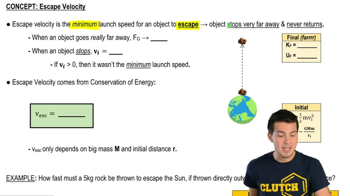
Escape Velocity

Escape velocity is the minimum speed an object must reach to break free from the gravitational pull of a celestial body without any additional propulsion. It depends on the mass of the body and the distance from its center. For the Sun, this velocity can be calculated using the formula v = √(2GM/r), where G is the gravitational constant, M is the mass of the Sun, and r is the distance from the Sun.
Video consigliato:
Percorso guidato
7:27
Escape Velocity

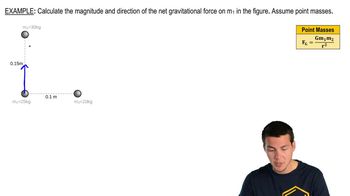
Gravitational Force

The gravitational force is the attractive force between two masses, described by Newton's law of universal gravitation. It states that the force is directly proportional to the product of the two masses and inversely proportional to the square of the distance between their centers. This force is crucial in determining the escape velocity, as it dictates how strongly the Sun pulls on objects at a given distance.
Video consigliato:
Percorso guidato
05:41
Gravitational Forces in 2D

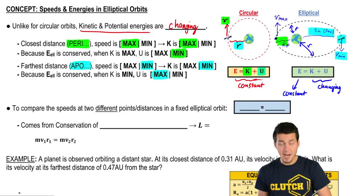
Orbital Speed

Orbital speed is the velocity required for an object to maintain a stable orbit around a celestial body. For Earth, this speed is approximately 29.78 km/s at an average distance from the Sun. Comparing escape velocity to orbital speed helps understand the dynamics of celestial motion, as an object must exceed escape velocity to leave the Sun's gravitational influence.
Video consigliato:
Percorso guidato
6:03
Speed and Energy of Elliptical Orbits
Pratica correlata
Domanda del libro di testo

A driver notices that her 950-kg car, when in neutral, slows down from 95 km/h to 65 km/h in about 7.0 s on a flat horizontal road. Approximately what power (watts and hp) is needed to keep the car traveling at a constant 80 km/h?

1984
views
Domanda del libro di testo

An 85-kg football player traveling 5.0 m/s is stopped in 1.0 s by a tackler. What average power is required to stop him?

1699
views
Domanda del libro di testo

A spring ( k = 75 N/m) has an equilibrium length of 1.00 m. The spring is compressed to a length of 0.50 m and a mass of 2.0 kg is placed at its free end on a frictionless slope which makes an angle of 41° with respect to the horizontal (Fig. 8–41). The spring is then released. Now the incline has a coefficient of kinetic friction μₖ. If the block, attached to the spring, is observed to stop just as it reaches the spring’s equilibrium position, what is the coefficient of friction μₖ?

866
views
Domanda del libro di testo

Early test flights for the space shuttle used a “glider” (mass of 980 kg including pilot). After a horizontal launch at 480 km/h at a height of 3200 m, the glider eventually landed at sea level with a speed of 210 km/h. What would its landing speed have been in the absence of air resistance?

1583
views
Domanda del libro di testo

The position of a 280-g object is given (in meters) by x = 4.0t³ - 8.0t² - 44t, where t is in seconds. What is the average net power input during the interval from t = 0s to t = 2.0 s, and in the interval from t = 2.0 s to 4.0 s?

2054
views
Domanda del libro di testo

Determine the escape velocity from the Sun for an object at the Sun’s surface ( r = 7.0 x 10⁵ km , M = 2.0 x 10³⁰ kg).

1712
views