
Ch. 08 - Conservation of Energy
Giancoli Douglas - Physics for Scientists and Engineers 5th edition
Giancoli Douglas5th editionPhysics for Scientists and EngineersISBN: 9780137488179Non è quello che usi tu?Cambia libro di testo
Capitolo 8, Problema 104a

The two atoms in a diatomic molecule exert an attractive force on each other at large distances and a repulsive force at short distances. The magnitude of the force between two atoms in a diatomic molecule can be approximated by the Lennard-Jones force, or F(r) = F₀ [2(σ/r)¹³ - (σ/r)⁷], where r is the separation between the two atoms, and σ and F₀ are constants. For an oxygen molecule (which is diatomic) F₀ = 9.60 x 10⁻¹¹ N and σ = 3.50 x 100⁻¹¹ m. Integrate the equation for F(r) to determine the potential energy U(r) of the oxygen molecule.

Guida verificata passo dopo passo
1
Start by recalling the relationship between force and potential energy. The force F(r) is related to the potential energy U(r) by the equation: F(r) = -dU(r)/dr. To find U(r), we need to integrate F(r) with respect to r.
Write the given force equation: F(r) = F₀ [2(σ/r)¹³ - (σ/r)⁷]. Substitute this into the integral for potential energy: U(r) = -∫F(r) dr = -∫F₀ [2(σ/r)¹³ - (σ/r)⁷] dr.
Separate the integral into two parts: U(r) = -F₀ ∫[2(σ/r)¹³] dr + F₀ ∫[(σ/r)⁷] dr. This allows us to handle each term individually.
For the first term, integrate 2(σ/r)¹³ with respect to r. Use the power rule for integration: ∫(rⁿ) dr = (rⁿ⁺¹)/(n+1), where n ≠ -1. The result will involve a term proportional to (σ/r)¹².
For the second term, integrate (σ/r)⁷ with respect to r using the same power rule. The result will involve a term proportional to (σ/r)⁶. Combine the results of both integrals, include the constant of integration, and simplify to express U(r) in terms of r, σ, and F₀.

Risposta video verificata per un problema simile:

Questa soluzione video è stata consigliata dai nostri tutor come utile per risolvere questo problema.
Durata del video:
6m

Concetti chiave

Ecco i concetti essenziali che devi comprendere per rispondere correttamente alla domanda.

Lennard-Jones Potential

The Lennard-Jones potential describes the interaction between a pair of neutral atoms or molecules. It combines an attractive term, which dominates at larger distances, and a repulsive term, which becomes significant at short distances. The potential energy U(r) can be derived from the force F(r) by integrating the force function, providing insights into molecular stability and behavior.
Video consigliato:
Percorso guidato
07:33
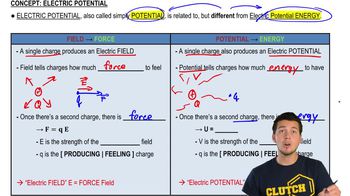
Electric Potential

Integration in Physics

Integration is a fundamental mathematical operation used to find quantities such as area under a curve, total displacement, or potential energy from force. In the context of the Lennard-Jones potential, integrating the force function F(r) with respect to the separation distance r allows us to derive the potential energy U(r) of the system, which is crucial for understanding molecular interactions.
Video consigliato:
Percorso guidato
11:43
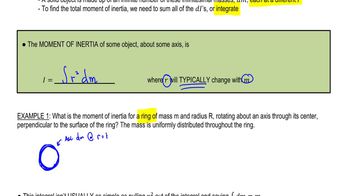
Finding Moment Of Inertia By Integrating

Potential Energy in Molecular Systems

Potential energy in molecular systems represents the stored energy due to the position of atoms relative to each other. It is a key concept in understanding molecular stability, bonding, and reactions. The shape of the potential energy curve derived from the Lennard-Jones potential indicates the equilibrium distance and the energy required to separate or compress the atoms, which is essential for predicting molecular behavior.
Video consigliato:
Percorso guidato
4:52
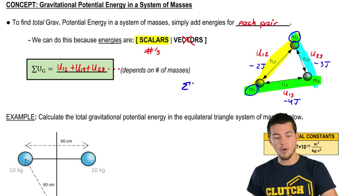
Gravitational Potential Energy for Systems of Masses