
Ch. 09 - Linear Momentum
Giancoli Douglas - Physics for Scientists and Engineers 5th edition
Giancoli Douglas5th editionPhysics for Scientists and EngineersISBN: 9780137488179Non è quello che usi tu?Cambia libro di testo
Capitolo 9, Problema 96

A fake hockey puck of mass 4m has been rigged to explode. Initially the puck is at rest on a frictionless ice rink. Then it bursts into three pieces. One chunk, of mass m, slides across the ice at velocity vî. Another chunk, of mass 2m, slides across the ice at velocity 2v ĵ. Determine the velocity of the third chunk.

Guida verificata passo dopo passo
1
Start by applying the principle of conservation of momentum. Since the puck was initially at rest, the total momentum of the system before the explosion is zero. Therefore, the total momentum of the three pieces after the explosion must also sum to zero.
Write the momentum equation in vector form. Let the velocity of the third chunk (mass m) be \( \vec{v}_3 = v_{3x} \hat{i} + v_{3y} \hat{j} \). The total momentum equation becomes: \( m \vec{v}_1 + 2m \vec{v}_2 + m \vec{v}_3 = 0 \), where \( \vec{v}_1 = v \hat{i} \) and \( \vec{v}_2 = 2v \hat{j} \).
Separate the momentum equation into components. For the x-direction: \( m(v) + 0 + m(v_{3x}) = 0 \). For the y-direction: \( 0 + 2m(2v) + m(v_{3y}) = 0 \).
Solve for \( v_{3x} \) in the x-direction equation: \( v_{3x} = -v \). Then solve for \( v_{3y} \) in the y-direction equation: \( v_{3y} = -4v \).
Combine the components to express the velocity of the third chunk as a vector: \( \vec{v}_3 = -v \hat{i} - 4v \hat{j} \).

Risposta video verificata per un problema simile:

Questa soluzione video è stata consigliata dai nostri tutor come utile per risolvere questo problema.
Durata del video:
6m

Concetti chiave

Ecco i concetti essenziali che devi comprendere per rispondere correttamente alla domanda.

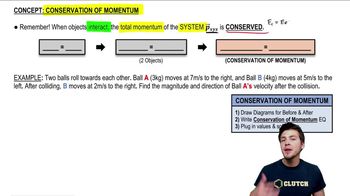
Conservation of Momentum

The principle of conservation of momentum states that the total momentum of a closed system remains constant if no external forces act on it. In this scenario, since the puck is initially at rest, the total momentum before the explosion is zero. After the explosion, the vector sum of the momenta of all pieces must also equal zero, allowing us to solve for the unknown velocity of the third chunk.
Video consigliato:
Percorso guidato
05:58
Conservation Of Momentum

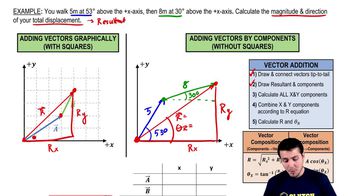
Vector Addition

Vector addition is the process of combining vectors to determine a resultant vector. In this problem, the velocities of the chunks are represented as vectors, and their components must be added separately in the x and y directions. This allows for the calculation of the third chunk's velocity by ensuring that the total momentum in each direction sums to zero.
Video consigliato:
Percorso guidato
07:30
Vector Addition By Components

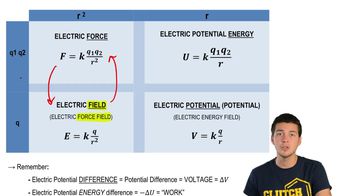
Mass and Velocity Relationship

The relationship between mass and velocity is crucial in momentum calculations, as momentum is defined as the product of mass and velocity (p = mv). In this case, the masses of the chunks and their respective velocities will be used to express the momentum of each piece. Understanding how these quantities interact is essential for applying the conservation of momentum to find the unknown velocity.
Video consigliato:
Percorso guidato
03:43
Relationships Between Force, Field, Energy, Potential
Pratica correlata
Domanda del libro di testo

Astronomers estimate that a 2.0-km-diameter asteroid collides with the Earth once every million years. The collision could pose a threat to life on Earth. Assume a spherical asteroid has a mass of 3200 kg for each cubic meter of volume and moves toward the Earth at 15 km/s. How much destructive energy could be released when it embeds itself in the Earth?

1773
views
Domanda del libro di testo

A rifle is aimed at a 2.0-kg block of wood along an inclined plane making an angle of 25°, as shown in Fig. 9–59. A 9.5-g bullet is fired at 760 m/s and becomes embedded in the block. How far up the incline does the block/bullet slide?

(a) Ignore the friction.

(b) Assume μₖ = 0.33.

82
views
Domanda del libro di testo

An astronaut of mass 210 kg including his suit and jet pack wants to acquire a velocity of 2.0 m/s to move back toward his space shuttle. Assuming the jet pack can eject gas with a velocity of 35 m/s, what mass of gas will need to be ejected?

1470
views
Domanda del libro di testo

The gravitational slingshot effect. Figure 9–62 shows the planet Saturn moving in the negative 𝓍 direction at its orbital speed (with respect to the Sun) of 9.6 km/s. The mass of Saturn is 5.69 x 10²⁶ kg. A spacecraft with mass 825 kg approaches Saturn. When far from Saturn, it moves in the +𝓍 direction at 10.4 km/s. The gravitational attraction of Saturn (a conservative force) acting on the spacecraft causes it to swing around the planet (orbit shown as dashed line) and head off in the opposite direction. Using momentum conservation in one dimension, estimate the final speed of the spacecraft after it is far enough away to be considered free of Saturn’s gravitational pull. Assume the spacecraft does not affect the orbit of Saturn whose mass is so much larger.

1683
views
Domanda del libro di testo

In order to convert a tough split in bowling, it is necessary to strike the pin a glancing blow as shown in Fig. 9–64. Assume that the bowling ball, traveling at 14.0 m/s just before it strikes the pin, has five times the mass of a pin and that the pin goes off at 75° from the original direction of the ball. Calculate the speed of the pin and (b) of the ball just after collision.

1221
views