Ch. 09 - Linear Momentum
Giancoli Douglas - Physics for Scientists and Engineers 5th edition
Giancoli Douglas5th editionPhysics for Scientists and EngineersISBN: 9780137488179Non è quello che usi tu?Cambia libro di testo
Capitolo 9, Problema 15

A mass mₐ = 2.0 kg, moving with velocity va→\(\overrightarrow{v_{a}\)} = (4.0 î + 5.0 ĵ ― 2.0 k̂) m/s, collides with mass m₈ = 3.0 kg, which is initially at rest. Immediately after the collision, mass mₐ is observed traveling at velocity va′→\(\overrightarrow{v_{a}\)^{\(\prime\)}} = (― 2.0 î + 3.0 k̂) m/s. Find the velocity of mass m₈ after the collision. Assume no outside force acts on the two masses during the collision.

Guida verificata passo dopo passo
1
Step 1: Understand the principle of conservation of momentum. In the absence of external forces, the total momentum of a system before and after a collision remains constant. Mathematically, this is expressed as: mₐvₐ + m₈v₈ = mₐv'ₐ + m₈v'₈, where v₈ is the initial velocity of mass m₈ (which is zero in this case), and v'₈ is the velocity of mass m₈ after the collision.
Step 2: Write the momentum conservation equation for each component (x, y, and z) separately. Since momentum is a vector quantity, we must conserve momentum in all three directions. For the x-component: mₐvₐₓ = mₐv'ₐₓ + m₈v'₈ₓ. For the y-component: mₐvₐᵧ = mₐv'ₐᵧ + m₈v'₈ᵧ. For the z-component: mₐvₐz = mₐv'ₐz + m₈v'₈z.
Step 3: Substitute the given values into the equations. For the x-component: 2.0(4.0) = 2.0(-2.0) + 3.0v'₈ₓ. For the y-component: 2.0(5.0) = 2.0(0) + 3.0v'₈ᵧ. For the z-component: 2.0(-2.0) = 2.0(3.0) + 3.0v'₈z.
Step 4: Solve each equation for the components of v'₈. For the x-component, isolate v'₈ₓ: v'₈ₓ = (expression after simplification). Repeat for the y- and z-components.
Step 5: Combine the components to express the final velocity of mass m₈ as a vector: v'₈ = v'₈ₓî + v'₈ᵧĵ + v'₈zk̂. Substitute the calculated values for v'₈ₓ, v'₈ᵧ, and v'₈z.

Risposta video verificata per un problema simile:

Questa soluzione video è stata consigliata dai nostri tutor come utile per risolvere questo problema.
Durata del video:
8m

Concetti chiave

Ecco i concetti essenziali che devi comprendere per rispondere correttamente alla domanda.

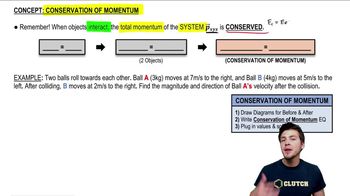
Conservation of Momentum

The principle of conservation of momentum states that in a closed system with no external forces, the total momentum before a collision is equal to the total momentum after the collision. Momentum is a vector quantity, calculated as the product of mass and velocity. In this scenario, the momentum of both masses before and after the collision must be equated to find the unknown velocity of mass m₈.
Video consigliato:
Percorso guidato
05:58
Conservation Of Momentum

Vector Addition

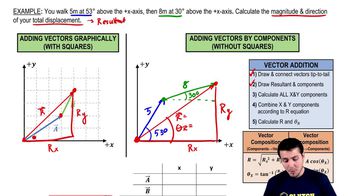
Vector addition is the process of combining two or more vectors to determine a resultant vector. In this problem, the velocities of the masses are represented as vectors, and their components must be added separately in the x, y, and z directions. Understanding how to manipulate these vectors is crucial for accurately calculating the final velocity of mass m₈ after the collision.
Video consigliato:
Percorso guidato
07:30
Vector Addition By Components

Elastic vs. Inelastic Collisions

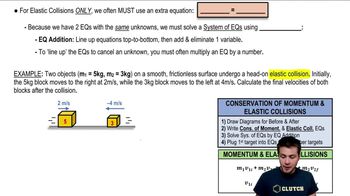
Collisions can be classified as elastic or inelastic based on whether kinetic energy is conserved. In this case, since the problem does not specify that kinetic energy is conserved, it is likely an inelastic collision, where the two masses may stick together or simply exchange momentum. Recognizing the type of collision helps in applying the correct principles to solve for the unknowns in the problem.
Video consigliato:
Percorso guidato
08:56
Intro To Elastic Collisions
Pratica correlata
Domanda del libro di testo

A 22-g bullet traveling 240 m/s penetrates a 2.0-kg block of wood and emerges going 130 m/s. If the block is stationary on a frictionless surface when hit, how fast does it move after the bullet emerges?

1356
views

Domanda del libro di testo

The force on a bullet along the barrel of a firearm is given by the formula F = [740 ― (2.3 x 10⁵ s⁻¹ ) t] N over the time interval t = 0 to t = 3.0 x 10⁻³ s. Plot a graph of F versus t for t = 0 to t = 3.0 ms. Use the graph to estimate the impulse given the bullet.

1664
views
Domanda del libro di testo

A 195-kg projectile, fired with a speed of 116 m/s at a 60.0° angle, breaks into three pieces of equal mass at the highest point of its arc (where its velocity is horizontal). Two of the fragments move with the same speed right after the explosion as the entire projectile had just before the explosion; one of these moves vertically downward and the other horizontally. Determine the velocity of the third fragment immediately after the explosion.

1337
views
Domanda del libro di testo

A 7150-kg railroad car travels alone on a level frictionless track with a constant speed of 15.0 m/s. A 3650-kg load, initially at rest, is dropped onto the car. What will be the car’s new speed?

1563
views
Domanda del libro di testo

The force on a bullet along the barrel of a firearm is given by the formula F = [740 ― (2.3 x 10⁵ s⁻¹ ) t] N over the time interval t = 0 to t = 3.0 x 10⁻³ s. Plot a graph of F versus t for t = 0 to t = 3.0 ms.

1783
views