
Ch. 09 - Linear Momentum
Giancoli Douglas - Physics for Scientists and Engineers 5th edition
Giancoli Douglas5th editionPhysics for Scientists and EngineersISBN: 9780137488179Non è quello che usi tu?Cambia libro di testo
Capitolo 9, Problema 73

A rocket traveling 1950 m/s away from the Earth at an altitude of 6400 km fires its rockets, which eject gas at a speed of 1200 m/s (relative to the rocket). If the mass of the rocket at this moment is 25,000 kg and an acceleration of 1.5 m/s² is desired, at what rate must the gases be ejected?

Guida verificata passo dopo passo
1
Step 1: Identify the key variables in the problem. The rocket's mass is \( m = 25,000 \, \text{kg} \), the desired acceleration is \( a = 1.5 \, \text{m/s}^2 \), and the relative velocity of the ejected gas is \( v_{\text{rel}} = 1200 \, \text{m/s} \). The goal is to find the rate of gas ejection \( \dot{m} \) (mass flow rate).
Step 2: Recall the thrust equation from Newton's second law for a rocket: \( F = \dot{m} v_{\text{rel}} \), where \( F \) is the force required to achieve the desired acceleration. The force can also be expressed as \( F = m a \). Equating these two expressions gives \( \dot{m} v_{\text{rel}} = m a \).
Step 3: Rearrange the equation to solve for \( \dot{m} \), the mass flow rate: \( \dot{m} = \frac{m a}{v_{\text{rel}}} \). This equation relates the mass flow rate to the rocket's mass, desired acceleration, and the relative velocity of the ejected gas.
Step 4: Substitute the given values into the equation: \( \dot{m} = \frac{25,000 \times 1.5}{1200} \). Perform the division to calculate the mass flow rate.
Step 5: Interpret the result. The calculated \( \dot{m} \) represents the rate at which the rocket must eject gas (in \( \text{kg/s} \)) to achieve the desired acceleration of \( 1.5 \, \text{m/s}^2 \).

Risposta video verificata per un problema simile:

Questa soluzione video è stata consigliata dai nostri tutor come utile per risolvere questo problema.
Durata del video:
6m

Concetti chiave

Ecco i concetti essenziali che devi comprendere per rispondere correttamente alla domanda.

Rocket Propulsion

Rocket propulsion is the process by which a rocket moves by expelling mass in the form of gas. According to Newton's third law, for every action, there is an equal and opposite reaction; thus, the ejection of gas generates thrust that propels the rocket forward. The effectiveness of this propulsion depends on the speed of the ejected gas and the mass of the rocket.
Video consigliato:

Thrust and Acceleration

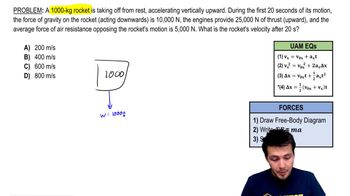
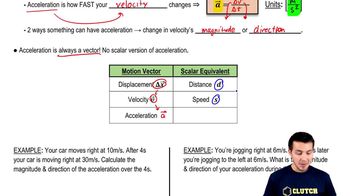
Thrust is the force exerted by the rocket engines to propel the rocket upward or forward. It can be calculated using Newton's second law, where thrust equals mass times acceleration (F = ma). To achieve a desired acceleration, the thrust must be sufficient to overcome both the gravitational force and any additional forces acting on the rocket.
Video consigliato:
Percorso guidato
05:47
Intro to Acceleration

Mass Flow Rate

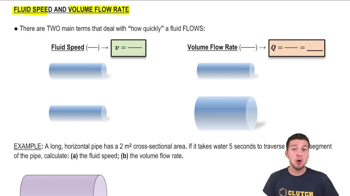
Mass flow rate is the amount of mass ejected per unit time, crucial for determining how much thrust a rocket can generate. It is calculated by dividing the thrust by the effective exhaust velocity of the gases. In this scenario, the mass flow rate must be adjusted to achieve the desired acceleration while considering the speed at which the gases are expelled relative to the rocket.
Video consigliato:
Percorso guidato
6:34
Fluid Speed & Volume Flow Rate
Pratica correlata
Domanda del libro di testo

A gun fires a bullet vertically into a 1.40-kg block of wood at rest on a thin horizontal sheet, Fig. 9–54. If the bullet has a mass of 15.0 g and a speed of 230 m/s, how high will the block rise into the air after the bullet becomes embedded in it?

1646
views
Domanda del libro di testo

A 0.145-kg baseball pitched horizontally at 35.0 m/s strikes a bat and pops straight up to a height of 31.5 m. If the contact time between bat and ball is 2.5 ms, calculate the average force between the ball and bat during contact.

1960
views
Domanda del libro di testo

The distance between a carbon atom (m = 12 u) and an oxygen atom (m = 16 u) in the CO molecule is 1.13 x 10⁻¹⁰ m. How far from the carbon atom is the center of mass of the molecule?

2022
views
Domanda del libro di testo

Find the center of mass of the ammonia molecule. The chemical formula is NH₃. The hydrogens are at the corners of an equilateral triangle (with sides 0.16 nm) that forms the base of a pyramid, with nitrogen at the apex (0.037 nm vertically above the plane of the triangle).

1599
views
Domanda del libro di testo

A 5.5-kg object moving in the +𝓍 direction at 6.5 m/s collides head-on with an 8.0-kg object moving in the ―𝓍 direction at 4.0 m/s. Determine the final velocity of each object if the objects stick together.

1395
views
Domanda del libro di testo

A huge balloon and its gondola, of mass M, are in the air and stationary with respect to the ground. A passenger, of mass m, then climbs out and slides down a rope with speed v, measured with respect to the balloon. With what speed and direction (relative to Earth) does the balloon then move? What happens if the passenger stops?

1592
views