
Ch. 10 - Rotational Motion
Giancoli Douglas - Physics for Scientists and Engineers 5th edition
Giancoli Douglas5th editionPhysics for Scientists and EngineersISBN: 9780137488179Non è quello che usi tu?Cambia libro di testo
Capitolo 10, Problema 104a

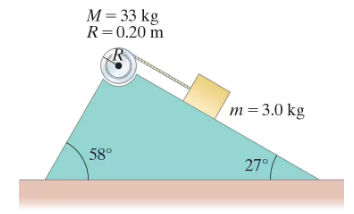
A cord connected at one end to a block which can slide on an inclined plane has its other end wrapped around a cylinder resting in a depression at the top of the plane as shown in Fig. 10–81. Determine the speed of the block after it has traveled 1.80 m along the plane, starting from rest. Assume there is no friction.
Diagram showing a block on an inclined plane connected by a cord to a cylinder, with angles and masses labeled.

Guida verificata passo dopo passo
1
Identify the forces acting on the system: The block is subject to gravitational force, tension in the cord, and the normal force from the inclined plane. The cylinder is subject to the tension in the cord and its own weight. Since there is no friction, we can ignore frictional forces.
Write the equations of motion for the block and the cylinder: For the block, use Newton's second law along the incline. The net force is the component of gravity along the incline minus the tension in the cord. For the cylinder, consider the torque caused by the tension in the cord, which will cause it to rotate.
Relate the linear acceleration of the block to the angular acceleration of the cylinder: Use the relationship between linear acceleration \( a \) and angular acceleration \( \alpha \), given by \( a = r \alpha \), where \( r \) is the radius of the cylinder.
Apply the work-energy principle: The block starts from rest, so its initial kinetic energy is zero. The work done by gravity on the block and the rotational kinetic energy of the cylinder will determine the final speed of the block. Use the equation \( \frac{1}{2}mv^2 + \frac{1}{2}I\omega^2 = mgh \), where \( I \) is the moment of inertia of the cylinder and \( \omega \) is its angular velocity.
Solve for the final speed of the block: Substitute \( \omega = \frac{v}{r} \) into the energy equation, and solve for \( v \). Use the given distance traveled by the block (1.80 m) to find the height \( h \) using trigonometry, \( h = d \sin(\theta) \), where \( \theta \) is the angle of the incline.

Risposta video verificata per un problema simile:

Questa soluzione video è stata consigliata dai nostri tutor come utile per risolvere questo problema.
Durata del video:
9m

Concetti chiave

Ecco i concetti essenziali che devi comprendere per rispondere correttamente alla domanda.

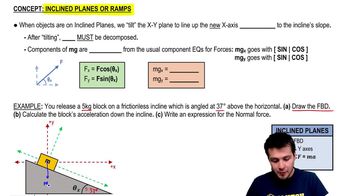
Inclined Plane Dynamics

An inclined plane is a flat surface tilted at an angle to the horizontal. When an object slides down an inclined plane, its motion is influenced by gravitational force, which can be resolved into components parallel and perpendicular to the surface. The parallel component causes acceleration down the slope, while the perpendicular component affects the normal force. Understanding these dynamics is crucial for analyzing the motion of the block.
Video consigliato:
Percorso guidato
06:59
Intro to Inclined Planes

Conservation of Energy

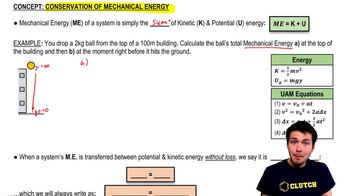
The principle of conservation of energy states that energy cannot be created or destroyed, only transformed from one form to another. In this scenario, the gravitational potential energy of the block is converted into kinetic energy as it slides down the incline. By applying this principle, we can relate the initial potential energy at the top of the incline to the kinetic energy of the block after it has traveled a certain distance.
Video consigliato:
Percorso guidato
06:24
Conservation Of Mechanical Energy

Kinematics of Motion

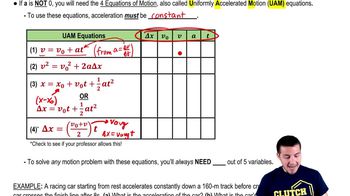
Kinematics is the branch of physics that describes the motion of objects without considering the forces that cause the motion. Key equations of motion relate displacement, initial velocity, final velocity, acceleration, and time. In this problem, we can use kinematic equations to determine the final speed of the block after it has traveled a specified distance along the incline, starting from rest.
Video consigliato:
Percorso guidato
08:25
Kinematics Equations