
Ch. 10 - Rotational Motion
Giancoli Douglas - Physics for Scientists and Engineers 5th edition
Giancoli Douglas5th editionPhysics for Scientists and EngineersISBN: 9780137488179Non è quello che usi tu?Cambia libro di testo
Capitolo 10, Problema 87c

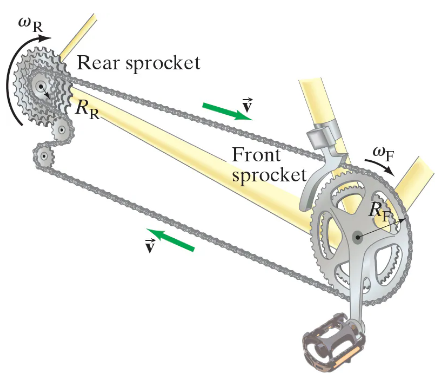
Bicycle gears:How is the angular velocity ωᵣ of the rear wheel of a bicycle related to the angular velocity ωբ of the front sprocket and pedals? Let Nբ and Nᵣ be the number of teeth on the front and rear sprockets, respectively, Fig. 10–71, and Rբ and Rᵣ their respective radii. The teeth are spaced the same on both sprockets and the rear sprocket is firmly attached to the rear wheel. Evaluate the ratio ωᵣ / ωբ when the front and rear sprocketshave 42 and 28 teeth.
Diagram illustrating the relationship between the angular velocities of a bicycle's front and rear sprockets and their respective radii.

Guida verificata passo dopo passo
1
Understand the relationship between the angular velocities of the front sprocket (ωբ) and the rear wheel (ωᵣ). The chain transfers motion from the front sprocket to the rear sprocket, so the linear speed of the chain is the same for both sprockets.
Express the linear speed of the chain in terms of the angular velocity and radius of the sprockets. For the front sprocket, the linear speed is v = Rբ * ωբ, and for the rear sprocket, it is v = Rᵣ * ωᵣ.
Since the linear speed of the chain is the same for both sprockets, set the two expressions equal: Rբ * ωբ = Rᵣ * ωᵣ.
Relate the radii of the sprockets to the number of teeth. The radius of a sprocket is proportional to the number of teeth, so Rբ / Rᵣ = Nբ / Nᵣ. Substitute this into the equation: (Nբ / Nᵣ) * ωբ = ωᵣ.
Rearrange the equation to find the ratio of angular velocities: ωᵣ / ωբ = Nբ / Nᵣ. Substitute the given values for the number of teeth (Nբ = 42, Nᵣ = 28) to evaluate the ratio.

Risposta video verificata per un problema simile:

Questa soluzione video è stata consigliata dai nostri tutor come utile per risolvere questo problema.
Durata del video:
6m

Concetti chiave

Ecco i concetti essenziali che devi comprendere per rispondere correttamente alla domanda.

Angular Velocity

Angular velocity (ω) is a measure of how quickly an object rotates around an axis, expressed in radians per second. In the context of a bicycle, it describes the rate at which the pedals and wheels turn. The relationship between the angular velocities of different components, such as the front sprocket and rear wheel, is crucial for understanding how gear ratios affect speed and torque.
Video consigliato:
Percorso guidato
06:18
Intro to Angular Momentum

Gear Ratio

The gear ratio is the ratio of the number of teeth on two gears that are meshed together. It determines how the angular velocities of the connected gears relate to each other. For bicycles, the gear ratio influences how much the rear wheel turns in relation to the pedals, affecting the bike's speed and the effort required to pedal.
Video consigliato:
Percorso guidato
05:32
Ratio of energies of cylinder on surface

Relationship Between Angular Velocities

The relationship between the angular velocities of the front sprocket (ωᵇ) and the rear wheel (ωᵣ) can be expressed using the gear ratio, which is derived from the number of teeth on the sprockets. Specifically, the ratio ωᵣ / ωᵇ can be calculated as the inverse of the gear ratio, which is determined by the number of teeth on the front and rear sprockets. This relationship is essential for evaluating how changes in gear affect the bicycle's performance.
Video consigliato:
Percorso guidato
03:43
Relationships Between Force, Field, Energy, Potential
Pratica correlata
Domanda del libro di testo

A 5.0-m-long ladder is leaning against the side of a building making a 35° angle with the building. When a person is about 1/3 of the way up, the ladder slips and falls to the ground in 3.0 s. What is the average angular acceleration of the ladder as it falls?

1248
views
Domanda del libro di testo

A hollow cylinder (hoop) is rolling on a horizontal surface at speed v = 3.0 m/s when it reaches an 18° incline. How far up the incline will it go?

1206
views
Domanda del libro di testo

The density (mass per unit length) of a thin rod of length ℓ increases uniformly from λ₀ at one end to 3λ₀ at the other end. Determine the moment of inertia about an axis perpendicular to the rod through its geometric center.

1220
views
Domanda del libro di testo

A cyclist accelerates from rest at a rate of 1.00 m/s². How fast will a point at the top of the rim of the tire (diameter = 68.0 cm) be moving after 2.75 s? [Hint: At any moment, the lowest point on the tire is in contact with the ground and is at rest—see Fig. 10–69.]

1444
views
Domanda del libro di testo

How is the angular velocity ωᵣ of the rear wheel of a bicycle related to the angular velocity ωբ of the front sprocket and pedals? Let Nբ and Nᵣ be the number of teeth on the front and rear sprockets, respectively, Fig. 10–71, and Rբ and Rᵣ their respective radii. The teeth are spaced the same on both sprockets and the rear sprocket is firmly attached to the rear wheel.

1384
views
Domanda del libro di testo

How is the angular velocity ωᵣ of the rear wheel of a bicycle related to the angular velocity ωբ of the front sprocket and pedals? Let Nբ and Nᵣ be the number of teeth on the front and rear sprockets, respectively, Fig. 10–71, and Rբ and Rᵣ their respective radii. The teeth are spaced the same on both sprockets and the rear sprocket is firmly attached to the rear wheel. Evaluate the ratio ωᵣ / ωբ when the front and rear sprockets have 52 and 13 teeth, respectively.

1509
views