
Ch. 10 - Rotational Motion
Giancoli Douglas - Physics for Scientists and Engineers 5th edition
Giancoli Douglas5th editionPhysics for Scientists and EngineersISBN: 9780137488179Non è quello che usi tu?Cambia libro di testo
Capitolo 10, Problema 42c

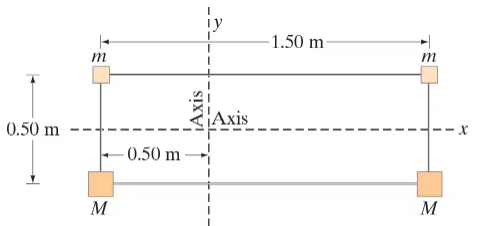
Calculate the moment of inertia of the array of point objects shown in Fig. 10–58 about the y axis, and the x axis. Assume m = 22kg, M = 3.2kg, and the objects are wired together by very light, rigid pieces of wire. The array is rectangular and is split through the middle by the x axis. About which axis would it be harder to accelerate this array?
Diagram of an array of point masses labeled m and M, showing distances and axes for calculating moment of inertia.

Guida verificata passo dopo passo
1
Step 1: Understand the problem. The moment of inertia (I) is a measure of an object's resistance to rotational acceleration about a given axis. For point masses, the moment of inertia is calculated using the formula: I=∑inmir2, where mi is the mass of the i-th object and ri is its perpendicular distance from the axis of rotation.
Step 2: Identify the distances of each mass from the y-axis. For the y-axis, the distances are determined by the x-coordinates of the masses. Use the given geometry of the rectangular array to find these distances. For example, if a mass is located at (x, y), its distance from the y-axis is |x|.
Step 3: Calculate the moment of inertia about the y-axis. Substitute the masses and their respective distances from the y-axis into the formula for moment of inertia. Sum the contributions of all the masses to get the total moment of inertia about the y-axis.
Step 4: Repeat the process for the x-axis. For the x-axis, the distances are determined by the y-coordinates of the masses. Use the same formula, but this time substitute the distances from the x-axis (|y|) and calculate the total moment of inertia about the x-axis.
Step 5: Compare the moments of inertia about the two axes. The axis with the larger moment of inertia will be harder to accelerate because it represents greater resistance to rotational motion. Use the calculated values to determine which axis this is.

Risposta video verificata per un problema simile:

Questa soluzione video è stata consigliata dai nostri tutor come utile per risolvere questo problema.
Durata del video:
12m

Concetti chiave

Ecco i concetti essenziali che devi comprendere per rispondere correttamente alla domanda.

Moment of Inertia

The moment of inertia is a measure of an object's resistance to changes in its rotational motion about a specific axis. It depends on the mass of the object and the distribution of that mass relative to the axis of rotation. For point masses, it is calculated as the sum of the products of each mass and the square of its distance from the axis. Understanding this concept is crucial for solving problems related to rotational dynamics.
Video consigliato:
Percorso guidato
11:47
Intro to Moment of Inertia

Rotational Dynamics

Rotational dynamics is the study of the effects of forces and torques on the motion of rotating bodies. It encompasses concepts such as angular momentum, torque, and the relationship between linear and angular quantities. In the context of the question, analyzing how the moment of inertia affects the acceleration of the array when subjected to torque is essential for understanding the dynamics of the system.
Video consigliato:
Percorso guidato
08:12
Torque & Acceleration (Rotational Dynamics)

Axis of Rotation

The axis of rotation is an imaginary line around which an object rotates. The choice of axis significantly influences the moment of inertia and, consequently, the object's rotational behavior. In this problem, comparing the moment of inertia about the x-axis and y-axis will help determine which axis makes it harder to accelerate the array, as the distribution of mass relative to each axis affects the overall resistance to rotational acceleration.
Video consigliato:
Percorso guidato
13:46
Parallel Axis Theorem
Pratica correlata
Domanda del libro di testo

Let us treat a helicopter rotor blade as a long thin rod, as shown in Fig. 10–60. If each of the three rotor helicopter blades is 3.75 m long and has a mass of 135 kg, calculate the moment of inertia of the three rotor blades about the axis of rotation.

1436
views
Domanda del libro di testo

Determine the net torque on the 2.0-m-long uniform beam shown in Fig. 10–56. All forces are shown. Calculate about point P at one end.

1756
views
Domanda del libro di testo

Suppose the force Fₜ in the cord hanging from the pulley of Example 10–10, Fig. 10–22, is given by the relation Fₜ = 3.00 t ― 0.20 t² (newtons) where t is in seconds. If the pulley starts from rest, what is the linear speed of a point on its rim 9.0 s later? Ignore friction and use the moment of inertia, calculated in Example 10–10.

1259
views
Domanda del libro di testo

The forearm in Fig. 10–57 accelerates a 3.6-kg ball at 7.0 m/s² by means of the triceps muscle, as shown. Calculate the torque needed.

1640
views
Domanda del libro di testo

A softball player swings a bat, accelerating it from rest to 2.4 rev/s in a time of 0.20 s. Approximate the bat as a 0.90-kg uniform rod of length 0.95 m, and compute the torque the player applies to one end of it.

1348
views
Domanda del libro di testo

A dad pushes tangentially on a small hand-driven merry-go-round and is able to accelerate it from rest to a frequency of 15 rpm in 10.0 s. Assume the merry-go-round is a uniform disk of radius 2.5 m and has a mass of 330 kg, and two children (each with a mass of 25 kg) sit opposite each other on the edge. Calculate the torque required to produce the acceleration, neglecting frictional torque. What force is required at the edge?

1565
views