Ch. 10 - Rotational Motion
Giancoli Douglas - Physics for Scientists and Engineers 5th edition
Giancoli Douglas5th editionPhysics for Scientists and EngineersISBN: 9780137488179Non è quello che usi tu?Cambia libro di testo
Capitolo 10, Problema 5c

The platter of the hard drive of a computer rotates at 7200 rpm (rpm = revolutions per minute = rev/min). If a single bit requires 0.50 μm of length along the direction of motion, how many bits per second can the writing head write when it is 3.00 cm from the axis?

Guida verificata passo dopo passo
1
Convert the rotational speed from revolutions per minute (rpm) to radians per second. Use the formula: \( \omega = \frac{2\pi \cdot \text{revolutions per minute}}{60} \), where \( \omega \) is the angular velocity in radians per second.
Determine the linear velocity \( v \) of the writing head at a distance \( r = 3.00 \; \text{cm} \) (or \( 0.030 \; \text{m} \)) from the axis. Use the relationship \( v = r \cdot \omega \), where \( r \) is the radius and \( \omega \) is the angular velocity.
Calculate the number of bits that can fit in one meter of the track. Since each bit requires \( 0.50 \; \mu\text{m} \) (or \( 0.50 \times 10^{-6} \; \text{m} \)), the number of bits per meter is given by \( \text{bits per meter} = \frac{1}{0.50 \times 10^{-6}} \).
Determine the number of bits written per second by multiplying the linear velocity \( v \) (in meters per second) by the number of bits per meter. Use the formula: \( \text{bits per second} = v \cdot \text{bits per meter} \).
Combine all the results to express the final answer in terms of bits per second, ensuring all units are consistent throughout the calculation.

Risposta video verificata per un problema simile:

Questa soluzione video è stata consigliata dai nostri tutor come utile per risolvere questo problema.
Durata del video:
6m

Concetti chiave

Ecco i concetti essenziali che devi comprendere per rispondere correttamente alla domanda.

Angular Velocity

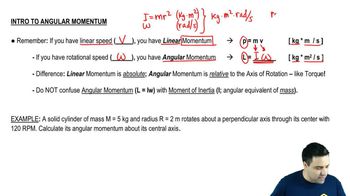
Angular velocity is the rate of rotation of an object, typically measured in radians per second. In this context, the platter's rotation speed of 7200 revolutions per minute (rpm) can be converted to radians per second to determine how quickly the writing head moves across the disk surface. Understanding angular velocity is crucial for calculating the linear speed at which data can be written.
Video consigliato:
Percorso guidato
06:18
Intro to Angular Momentum

Linear Speed

Linear speed refers to the distance traveled per unit of time along a straight path. For a rotating object, linear speed can be calculated using the formula v = rω, where v is linear speed, r is the radius (distance from the axis of rotation), and ω is the angular velocity. This concept is essential for determining how fast the writing head can move across the platter to write data.
Video consigliato:
Percorso guidato
07:31
Linear Thermal Expansion

Data Transfer Rate

Data transfer rate is the amount of data that can be written or read in a given time period, typically measured in bits per second. In this scenario, the transfer rate can be calculated by dividing the linear speed of the writing head by the length required for each bit. This concept is vital for understanding how efficiently data can be recorded on the hard drive.
Video consigliato:
Percorso guidato
05:14
Overview of Heat Transfer