
Ch. 10 - Rotational Motion
Giancoli Douglas - Physics for Scientists and Engineers 5th edition
Giancoli Douglas5th editionPhysics for Scientists and EngineersISBN: 9780137488179Non è quello che usi tu?Cambia libro di testo
Capitolo 10, Problema 58

(III) Integrate to derive the formula for the moment of inertia of a uniform thin rod of length ℓ about an axis through its center, perpendicular to the rod (see Fig. 10–21f).

Guida verificata passo dopo passo
1
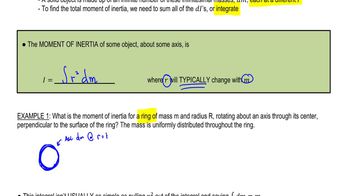
Start by recalling the formula for the moment of inertia: \( I = \int r^2 \, dm \), where \( r \) is the perpendicular distance from the axis of rotation to the mass element \( dm \).
Define the mass element \( dm \) in terms of the linear mass density \( \lambda \), where \( \lambda = \frac{M}{\ell} \) (\( M \) is the total mass of the rod and \( \ell \) is its length). Thus, \( dm = \lambda \, dx \), where \( dx \) is a small segment of the rod.
Set up the coordinate system: Place the center of the rod at the origin of the \( x \)-axis, so the rod extends from \( -\ell/2 \) to \( \ell/2 \). The distance \( r \) from the axis of rotation to a small segment of the rod is simply \( |x| \).
Substitute \( r \) and \( dm \) into the moment of inertia formula: \( I = \int_{-\ell/2}^{\ell/2} x^2 \lambda \, dx \). Replace \( \lambda \) with \( \frac{M}{\ell} \), giving \( I = \frac{M}{\ell} \int_{-\ell/2}^{\ell/2} x^2 \, dx \).
Evaluate the integral: \( \int_{-\ell/2}^{\ell/2} x^2 \, dx \). Use the symmetry of the function \( x^2 \) about the origin to simplify the integral to \( 2 \int_{0}^{\ell/2} x^2 \, dx \). Solve this integral and multiply by \( \frac{M}{\ell} \) to find the final expression for \( I \).

Risposta video verificata per un problema simile:

Questa soluzione video è stata consigliata dai nostri tutor come utile per risolvere questo problema.
Durata del video:
5m

Concetti chiave

Ecco i concetti essenziali che devi comprendere per rispondere correttamente alla domanda.

Moment of Inertia

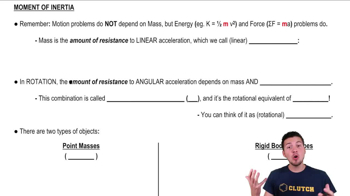
The moment of inertia is a measure of an object's resistance to rotational motion about a specific axis. It depends on the mass distribution relative to that axis, with greater distances from the axis resulting in a higher moment of inertia. For a uniform thin rod, this concept is crucial as it quantifies how the rod will respond to applied torques.
Video consigliato:
Percorso guidato
11:47
Intro to Moment of Inertia

Integration in Physics

Integration is a mathematical process used to calculate quantities that accumulate over a continuous range, such as mass distribution along a rod. In deriving the moment of inertia, integration allows us to sum the contributions of infinitesimally small mass elements across the length of the rod, providing a comprehensive measure of its rotational inertia.
Video consigliato:
Percorso guidato
11:43
Finding Moment Of Inertia By Integrating

Axis of Rotation

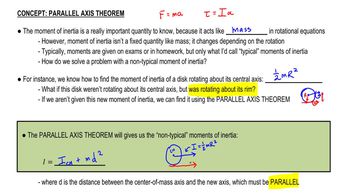
The axis of rotation is the line about which an object rotates. In this case, the axis is through the center of the rod and perpendicular to its length. The choice of axis significantly affects the moment of inertia, as it determines how the mass is distributed relative to that axis, influencing the rod's rotational dynamics.
Video consigliato:
Percorso guidato
13:46
Parallel Axis Theorem
Pratica correlata
Domanda del libro di testo

To get a flat, uniform cylindrical satellite spinning at the correct rate, engineers fire four tangential rockets as shown in Fig. 10–61. Suppose that the satellite has a mass of 3600 kg and a radius of 4.0 m, and that the rockets each add a mass of 250 kg. What is the steady force required of each rocket if the satellite is to reach 28 rpm in 5.0 min, starting from rest?

1561
views
Domanda del libro di testo

Two blocks are connected by a light string passing over a pulley of radius 0.15 m and moment of inertia I. The blocks move (towards the right) with an acceleration of 1.00 m/s² along their frictionless inclines (see Fig. 10–62). Find the net torque acting on the pulley, and determine its moment of inertia, I.

1681
views
Domanda del libro di testo

A bowling ball of mass 7.3 kg and radius 9.0 cm rolls without slipping down a lane at 3.7 m/s. Calculate its total kinetic energy.

1596
views
Domanda del libro di testo

Suppose the force Fₜ in the cord hanging from the pulley of Example 10–10, Fig. 10–22, is given by the relation Fₜ = 3.00 t ― 0.20 t² (newtons) where t is in seconds. If the pulley starts from rest, what is the linear speed of a point on its rim 9.0 s later? Ignore friction and use the moment of inertia, calculated in Example 10–10.

1259
views
Domanda del libro di testo

A 2.30-m-long pole is balanced vertically on its tip. It starts to fall and its lower end does not slip. What will be the speed of the upper end of the pole just before it hits the ground? [Hint: Use conservation of energy.]

1017
views
Domanda del libro di testo

II) A uniform solid sphere of radius r0 = 24.5 cm and mass m = 1.60 kg starts from rest and rolls without slipping down a 30.0° incline that is 10.0 m long. Calculate its translational and rotational speeds when it reaches the bottom. Avoid putting in numbers until the end so you can answer.

1429
views