
Ch. 10 - Rotational Motion
Giancoli Douglas - Physics for Scientists and Engineers 5th edition
Giancoli Douglas5th editionPhysics for Scientists and EngineersISBN: 9780137488179Non è quello che usi tu?Cambia libro di testo
Capitolo 10, Problema 79b

The 1100-kg mass of a car includes four tires, each of mass 35 kg (including wheels) and diameter 0.80 m. Assume each tire and wheel combination acts as a solid cylinder. Determine the fraction of the kinetic energy in the tires and wheels.

Guida verificata passo dopo passo
1
Determine the total mass of the car excluding the tires. Subtract the combined mass of the four tires from the total mass of the car: \( m_{car} = 1100 \ \text{kg} - 4 \times 35 \ \text{kg} \).
Calculate the moment of inertia of a single tire, treating it as a solid cylinder. The formula for the moment of inertia of a solid cylinder rotating about its central axis is \( I = \frac{1}{2} m r^2 \), where \( m \) is the mass of the tire and \( r \) is its radius. Use the given diameter of 0.80 m to find the radius \( r = \frac{0.80}{2} \ \text{m} \).
Determine the rotational kinetic energy of all four tires. The rotational kinetic energy of a single tire is given by \( KE_{rot} = \frac{1}{2} I \omega^2 \), where \( \omega \) is the angular velocity. Since all four tires are identical, multiply the rotational kinetic energy of one tire by 4.
Calculate the translational kinetic energy of the car. The formula for translational kinetic energy is \( KE_{trans} = \frac{1}{2} m v^2 \), where \( m \) is the total mass of the car (including the tires) and \( v \) is the linear velocity. Note that the linear velocity \( v \) is related to the angular velocity \( \omega \) of the tires by \( v = r \omega \).
Find the fraction of the total kinetic energy that is in the tires and wheels. The total kinetic energy is the sum of the translational kinetic energy and the rotational kinetic energy of the tires. The fraction is given by \( \text{Fraction} = \frac{KE_{rot}}{KE_{total}} \), where \( KE_{total} = KE_{trans} + KE_{rot} \).

Risposta video verificata per un problema simile:

Questa soluzione video è stata consigliata dai nostri tutor come utile per risolvere questo problema.
Durata del video:
11m

Concetti chiave

Ecco i concetti essenziali che devi comprendere per rispondere correttamente alla domanda.

Kinetic Energy

Kinetic energy is the energy an object possesses due to its motion, calculated using the formula KE = 1/2 mv², where m is the mass and v is the velocity of the object. In the context of the car, both the translational kinetic energy of the car's mass and the rotational kinetic energy of the tires must be considered to determine the total kinetic energy.
Video consigliato:
Percorso guidato
06:07
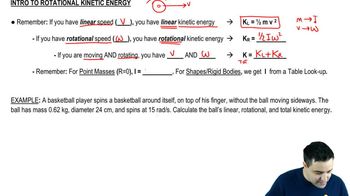
Intro to Rotational Kinetic Energy

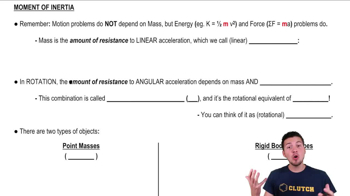
Moment of Inertia

Moment of inertia is a measure of an object's resistance to changes in its rotation and depends on the mass distribution relative to the axis of rotation. For solid cylinders, the moment of inertia can be calculated using the formula I = 1/2 m r², where m is the mass and r is the radius. This concept is crucial for understanding how the tires contribute to the overall kinetic energy of the car.
Video consigliato:
Percorso guidato
11:47
Intro to Moment of Inertia

Fraction of Kinetic Energy

The fraction of kinetic energy refers to the proportion of the total kinetic energy that is attributed to a specific part of a system, in this case, the tires and wheels of the car. To find this fraction, one must calculate the kinetic energy of the tires and wheels separately and then divide it by the total kinetic energy of the car, allowing for a clear understanding of how much energy is involved in the motion of the tires.
Video consigliato:
Percorso guidato
06:18
Kinetic Friction Problems
Pratica correlata
Domanda del libro di testo

The 1100-kg mass of a car includes four tires, each of mass 35 kg (including wheels) and diameter 0.80 m. Assume each tire and wheel combination acts as a solid cylinder. Determine the total kinetic energy of the car when traveling 95 km/h.

1451
views
Domanda del libro di testo

A cyclist accelerates from rest at a rate of 1.00 m/s². How fast will a point at the top of the rim of the tire (diameter = 68.0 cm) be moving after 2.75 s? [Hint: At any moment, the lowest point on the tire is in contact with the ground and is at rest—see Fig. 10–69.]

1444
views
Domanda del libro di testo

How is the angular velocity ωᵣ of the rear wheel of a bicycle related to the angular velocity ωբ of the front sprocket and pedals? Let Nբ and Nᵣ be the number of teeth on the front and rear sprockets, respectively, Fig. 10–71, and Rբ and Rᵣ their respective radii. The teeth are spaced the same on both sprockets and the rear sprocket is firmly attached to the rear wheel.

1384
views
Domanda del libro di testo

On a 12.0-cm-diameter audio compact disc (CD), digital bits of information are encoded sequentially along an outward spiraling path. The spiral starts at radius R₁ = 2.5 cm and winds its way out to radius R₂ = 5.8 cm. To read the digital information, a CD player rotates the CD so that the player’s readout laser scans along the spiral’s sequence of bits at a constant linear speed of 1.25 m/s. Thus the player must accurately adjust the rotational frequency ƒ of the CD as the laser moves outward. Determine the values for ƒ (in units of rpm) when the laser is located at R₁ and when it is at R₂.

1462
views
Domanda del libro di testo

A solid rubber ball rests on the floor of a railroad car when the car begins moving with acceleration a. Assuming the ball rolls without slipping, what is its acceleration relative to the car?

1525
views
Domanda del libro di testo

A solid rubber ball rests on the floor of a railroad car when the car begins moving with acceleration a. Assuming the ball rolls without slipping, what is its acceleration relative to the ground?

1549
views