
Ch. 11 - Angular Momentum; General Rotation
Giancoli Douglas - Physics for Scientists and Engineers 5th edition
Giancoli Douglas5th editionPhysics for Scientists and EngineersISBN: 9780137488179Non è quello che usi tu?Cambia libro di testo
Capitolo 11, Problema 53b

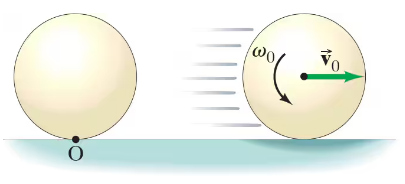
On a level billiards table a cue ball, initially at rest at point O on the table, is struck so that it leaves the cue stick with a center-of-mass speed v₀ and ω₀ a “reverse” spin of angular speed (see Fig. 11–41). A kinetic friction force acts on the ball as it initially skids across the table. Using conservation of angular momentum, find the critical angular speed ωC such that, if ω₀=ωC, kinetic friction will bring the ball to a complete (as opposed to momentary) stop.
A cue ball at rest at point O, then struck, showing its speed v₀ and reverse spin ω₀ on a billiards table.

Guida verificata passo dopo passo
1
Identify the key concepts involved: The problem involves the conservation of angular momentum, the relationship between linear and angular motion, and the effect of kinetic friction on the motion of the cue ball. The goal is to find the critical angular speed ω_C such that the ball comes to a complete stop due to friction.
Write the relationship between the linear velocity v and angular velocity ω of the ball when rolling without slipping: v = ωR, where R is the radius of the ball. This condition is important because it determines when the ball transitions from skidding to rolling motion.
Express the torque due to the kinetic friction force: The torque τ caused by the friction force F_k is given by τ = F_kR. This torque changes the angular velocity of the ball over time.
Apply the conservation of angular momentum: The initial angular momentum of the system is the sum of the linear and rotational components. The critical angular speed ω_C is the value of ω₀ such that the total angular momentum becomes zero when the ball stops. Use the equation L_initial = L_final, where L_initial = Iω₀ + mR(v₀) and L_final = 0. Here, I is the moment of inertia of the ball, and m is its mass.
Substitute the moment of inertia for a solid sphere: For a solid sphere, I = (2/5)mR². Substitute this into the angular momentum equation and solve for ω_C in terms of v₀, R, and other constants. The result will show the critical angular speed required for the ball to stop due to friction.

Risposta video verificata per un problema simile:

Questa soluzione video è stata consigliata dai nostri tutor come utile per risolvere questo problema.
Durata del video:
4m

Concetti chiave

Ecco i concetti essenziali che devi comprendere per rispondere correttamente alla domanda.

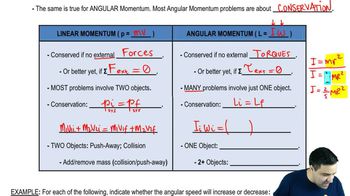
Conservation of Angular Momentum

The principle of conservation of angular momentum states that if no external torque acts on a system, the total angular momentum of that system remains constant. In this scenario, the cue ball's angular momentum before and after it is struck must be analyzed to determine how its spin affects its motion across the table.
Video consigliato:
Percorso guidato
12:12
Conservation of Angular Momentum

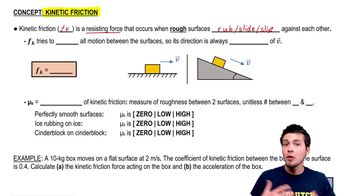
Kinetic Friction

Kinetic friction is the force that opposes the motion of two surfaces sliding past each other. In the context of the cue ball, this force acts to slow down the ball as it skids across the table, and its magnitude depends on the coefficient of kinetic friction and the normal force acting on the ball.
Video consigliato:
Percorso guidato
06:18
Kinetic Friction Problems

Critical Angular Speed (ω_C)

The critical angular speed (ω_C) is the threshold angular speed at which the cue ball will stop completely due to the effects of kinetic friction. If the initial angular speed (ω₀) is equal to ω_C, the frictional force will be sufficient to bring the ball to a complete stop, balancing the forces acting on it.
Video consigliato:
Pratica correlata
Domanda del libro di testo

A toy gyroscope consists of a 170-g disk with a radius of 5.5 cm mounted at the center of a thin axle 21 cm long (Fig. 11–42). The gyroscope spins at 45 rev/s. One end of its axle rests on a stand and the other end precesses horizontally about the stand. How long does it take the gyroscope to precess once around?

77
views
Domanda del libro di testo

Two ice skaters, both of mass 68 kg, approach on parallel paths 1.6 m apart. Both are moving at 3.5 m/s with their arms outstretched. They join hands as they pass, still maintaining their 1.6-m separation, and begin rotating about one another. Treat the skaters as particles with regard to their rotational inertia. If they now pull on each other’s hands, reducing their radius to half its original value, what is their common angular speed after reducing their radius?

915
views
Domanda del libro di testo

On a level billiards table a cue ball, initially at rest at point O on the table, is struck so that it leaves the cue stick with a center-of-mass speed v₀ and ω₀ a “reverse” spin of angular speed (see Fig. 11–41). A kinetic friction force acts on the ball as it initially skids across the table. If ω₀ is 10% smaller than ωC , i.e., ω₀ = 0.90ωC, determine the ball’s cm velocity vCM when it starts to roll without slipping.

906
views
Domanda del libro di testo

Suppose a 5.2 x 10¹⁰kg meteorite struck the Earth at the equator with a speed v = 2.2 x 10⁴ m/s, as shown in Fig. 11–38 and remained stuck. By what factor would this affect the rotational frequency of the Earth (1 rev/day)?

<IMAGE>

1607
views
Domanda del libro di testo

Two ice skaters, both of mass 68 kg, approach on parallel paths 1.6 m apart. Both are moving at 3.5 m/s with their arms outstretched. They join hands as they pass, still maintaining their 1.6-m separation, and begin rotating about one another. Treat the skaters as particles with regard to their rotational inertia. They now pull on each other’s hands, reducing their radius to half its original value. Calculate the change in kinetic energy for this process.

1341
views
Domanda del libro di testo

Suppose the solid wheel of Fig. 11–42 has a mass of 260 g and rotates at 85 rad/s; it has radius 6.0 cm and is mounted at the center of a horizontal thin axle 25 cm long. At what rate does the axle precess?

140
views