Ch. 13 - Fluids
Giancoli Douglas - Physics for Scientists and Engineers 5th edition
Giancoli Douglas5th editionPhysics for Scientists and EngineersISBN: 9780137488179Non è quello che usi tu?Cambia libro di testo
Capitolo 13, Problema 46

How fast does water flow from a hole at the bottom of a very wide, 5.1-m-deep storage tank filled with water? Ignore viscosity.

Guida verificata passo dopo passo
1
Identify the principle governing the problem: This is a fluid dynamics problem that can be solved using Torricelli's theorem, which states that the speed of efflux of a fluid under gravity through a hole is given by \( v = \sqrt{2gh} \), where \( g \) is the acceleration due to gravity and \( h \) is the height of the fluid above the hole.
Determine the known values: From the problem, the height of the water column above the hole is \( h = 5.1 \, \text{m} \), and the acceleration due to gravity is \( g = 9.8 \; \text{m/s}^2 \).
Substitute the known values into Torricelli's formula: \( v = \sqrt{2 \cdot 9.8 \cdot 5.1} \).
Simplify the expression under the square root: Calculate \( 2 \cdot 9.8 \cdot 5.1 \) to find the value inside the square root.
Take the square root of the result from the previous step to find the speed of the water flowing out of the hole.

Risposta video verificata per un problema simile:

Questa soluzione video è stata consigliata dai nostri tutor come utile per risolvere questo problema.
Durata del video:
5m

Concetti chiave

Ecco i concetti essenziali che devi comprendere per rispondere correttamente alla domanda.

Torricelli's Law

Torricelli's Law states that the speed of fluid flowing out of an orifice under the force of gravity is proportional to the square root of the height of the fluid above the opening. Mathematically, it can be expressed as v = √(2gh), where v is the exit speed, g is the acceleration due to gravity, and h is the height of the fluid column. This principle is crucial for determining the flow speed of water from the tank.
Video consigliato:

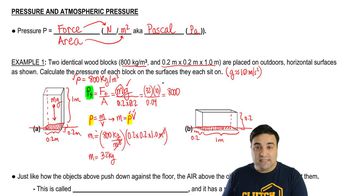
Hydrostatic Pressure

Hydrostatic pressure is the pressure exerted by a fluid at rest due to the weight of the fluid above it. In the context of the tank, the pressure at the hole is determined by the height of the water column, which influences the speed of the water exiting the hole. The deeper the water, the greater the hydrostatic pressure, leading to a higher flow speed.
Video consigliato:
Percorso guidato
17:04
Pressure and Atmospheric Pressure

Conservation of Energy

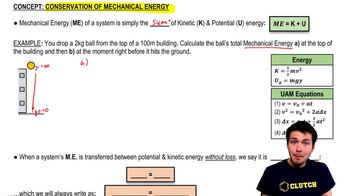
The principle of conservation of energy states that energy cannot be created or destroyed, only transformed from one form to another. In fluid dynamics, this principle applies as the potential energy of the water at height h is converted into kinetic energy as it flows out of the hole. This relationship is fundamental in deriving the equations that describe fluid flow, including the application of Torricelli's Law.
Video consigliato:
Percorso guidato
06:24
Conservation Of Mechanical Energy