Ch. 13 - Fluids
Giancoli Douglas - Physics for Scientists and Engineers 5th edition
Giancoli Douglas5th editionPhysics for Scientists and EngineersISBN: 9780137488179Non è quello che usi tu?Cambia libro di testo
Capitolo 13, Problema 19

Determine the minimum gauge pressure needed in the water pipe leading into a building if water is to come out of a faucet on the fourteenth floor, 44 m above that pipe.

Guida verificata passo dopo passo
1
Identify the key concept: The problem involves determining the minimum gauge pressure required to lift water to a height of 44 m. This is a fluid mechanics problem that uses the relationship between pressure, height, and density in a static fluid.
Use the hydrostatic pressure formula: The pressure required to lift a fluid to a certain height is given by the equation: P=ρgh, where ρ is the density of water (approximately 1000 kg/m³), g is the acceleration due to gravity (9.8 m/s²), and h is the height (44 m).
Substitute the known values into the formula: Replace ρ with 1000 kg/m³, g with 9.8 m/s², and h with 44 m in the equation P=ρgh.
Recognize that the result from the formula gives the absolute pressure due to the water column. To find the gauge pressure, note that gauge pressure excludes atmospheric pressure. Since the problem asks for the minimum gauge pressure, the atmospheric pressure is not added to the result.
Conclude the calculation: After substituting the values and performing the multiplication, the result will give the minimum gauge pressure in Pascals (Pa). Ensure the units are consistent throughout the calculation.

Risposta video verificata per un problema simile:

Questa soluzione video è stata consigliata dai nostri tutor come utile per risolvere questo problema.
Durata del video:
2m

Concetti chiave

Ecco i concetti essenziali che devi comprendere per rispondere correttamente alla domanda.

Gauge Pressure

Gauge pressure is the pressure relative to atmospheric pressure. It is the pressure measured in a system that excludes the atmospheric pressure acting on the fluid. In this context, it is crucial to determine how much additional pressure is needed in the water pipe to ensure that water can reach the faucet on the fourteenth floor.
Video consigliato:
Percorso guidato
09:27
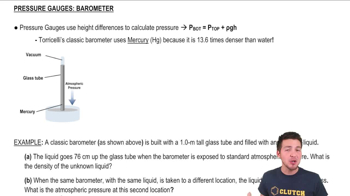
Pressure Gauges: Barometer

Hydrostatic Pressure

Hydrostatic pressure is the pressure exerted by a fluid at equilibrium due to the force of gravity. It increases with depth in a fluid and is calculated using the formula P = ρgh, where P is the pressure, ρ is the fluid density, g is the acceleration due to gravity, and h is the height of the fluid column. This concept is essential for calculating the pressure needed to lift water to a specific height.
Video consigliato:
Percorso guidato
17:04
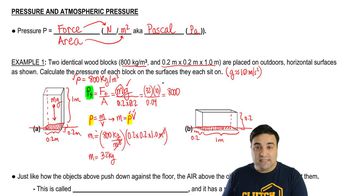
Pressure and Atmospheric Pressure

Bernoulli's Principle

Bernoulli's Principle states that in a flowing fluid, an increase in velocity occurs simultaneously with a decrease in pressure or potential energy. This principle helps in understanding how pressure changes in a fluid system, which is important when considering the flow of water from the pipe to the faucet at a higher elevation.
Video consigliato:
Percorso guidato
14:47
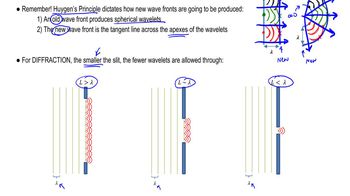
Diffraction with Huygen's Principle
Pratica correlata
Domanda del libro di testo

A 0.48-kg piece of wood floats in water but is found to sink in alcohol (SG = 0.79), in which it has an apparent mass of 0.047 kg. What is the SG of the wood?

1324
views

Domanda del libro di testo

A house at the bottom of a hill is fed by a full tank of water 6.0 m deep and connected to the house by a pipe that is 75 m long at an angle of 61° from the horizontal (Fig. 13–53). How high could the water shoot if it came vertically out of a broken pipe in front of the house?

1538
views
Domanda del libro di testo

Calculate the true mass (in vacuum) of an aluminum sphere whose apparent mass is 4.0000 kg when weighed in air.

1361
views
Domanda del libro di testo

An open-tube mercury manometer is used to measure the pressure in an oxygen tank. When the atmospheric pressure is 1040 mbar, what is the absolute pressure (in Pa) in the tank if the height of the mercury in the open tube is 7.6 cm lower than the mercury in the tube connected to the tank? See Fig. 13–10a.

1528
views
Domanda del libro di testo

The Earth is not a uniform sphere, but has regions of varying density. Consider a simple model of the Earth divided into three regions—inner core, outer core, and mantle. Let us assume each region has a constant density (the average density of that region in the real Earth). Use this model to predict the average density of the entire Earth.

1601
views
Domanda del libro di testo

A house at the bottom of a hill is fed by a full tank of water 6.0 m deep and connected to the house by a pipe that is 75 m long at an angle of 61° from the horizontal (Fig. 13–53). Determine the water gauge pressure at the house.

1190
views
1
rank