
Ch. 13 - Fluids
Giancoli Douglas - Physics for Scientists and Engineers 5th edition
Giancoli Douglas5th editionPhysics for Scientists and EngineersISBN: 9780137488179Non è quello che usi tu?Cambia libro di testo
Capitolo 13, Problema 85

When you ascend or descend a great deal when driving in a car, your ears “pop,” which means that the pressure behind the eardrum is being equalized to that outside. If this did not happen, what would be the approximate force on an eardrum of area 0.20cm² if a change in altitude of 1120 m takes place?

Guida verificata passo dopo passo
1
Convert the area of the eardrum from cm² to m². Use the conversion factor: 1 cm² = 1 × 10⁻⁴ m². Thus, the area in m² is A = 0.20 × 10⁻⁴ m².
Determine the change in atmospheric pressure due to the change in altitude. Use the approximate relationship for atmospheric pressure change: ΔP = ρgh, where ρ is the density of air (approximately 1.225 kg/m³ at sea level), g is the acceleration due to gravity (9.8 m/s²), and h is the change in altitude (1120 m).
Substitute the values into the formula ΔP = ρgh to calculate the pressure difference. This gives ΔP = (1.225)(9.8)(1120).
Calculate the force exerted on the eardrum using the formula F = ΔP × A, where F is the force, ΔP is the pressure difference, and A is the area of the eardrum in m².
Substitute the values of ΔP and A into the formula F = ΔP × A to find the approximate force on the eardrum. Ensure the units are consistent throughout the calculation.

Risposta video verificata per un problema simile:

Questa soluzione video è stata consigliata dai nostri tutor come utile per risolvere questo problema.
Durata del video:
3m

Concetti chiave

Ecco i concetti essenziali che devi comprendere per rispondere correttamente alla domanda.

Pressure Change

Pressure is defined as force per unit area. When there is a change in altitude, the atmospheric pressure changes, which can exert a force on surfaces, such as the eardrum. Understanding how pressure varies with altitude is crucial for calculating the force acting on the eardrum during ascent or descent.
Video consigliato:
Percorso guidato
17:04
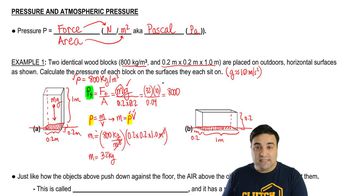
Pressure and Atmospheric Pressure

Atmospheric Pressure

Atmospheric pressure decreases with increasing altitude due to the reduction in the weight of the air above. At sea level, the standard atmospheric pressure is approximately 101,325 Pa. As one ascends, this pressure drops, and the difference between the internal ear pressure and external atmospheric pressure can lead to the sensation of 'popping' as the eardrum equalizes.
Video consigliato:
Percorso guidato
17:04
Pressure and Atmospheric Pressure

Force Calculation

The force exerted on an area can be calculated using the formula F = P × A, where F is the force, P is the pressure difference, and A is the area. In this scenario, knowing the change in atmospheric pressure due to altitude change allows us to compute the force acting on the eardrum, which has a specific area of 0.20 cm².
Video consigliato:
Percorso guidato
06:09
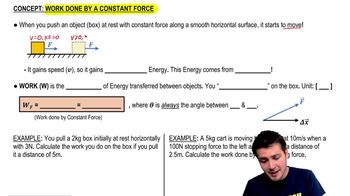
Work Done by a Constant Force
Pratica correlata
Domanda del libro di testo

You are watering your lawn with a hose when you put your finger over the hose opening to increase the distance the water reaches. If you are holding the hose horizontally, and the distance the water reaches increases by a factor of 4, what fraction of the hose opening did you block?

1177
views
Domanda del libro di testo

A 3.2-N force is applied to the plunger of a hypodermic needle. If the diameter of the plunger is 1.3 cm and that of the needle is 0.20 mm, what force on the plunger would be needed to push fluid into a vein where the gauge pressure is 75 mm-Hg? Answer for the instant just before the fluid starts to move.

802
views
Domanda del libro di testo

A hydraulic lift is used to jack a 960-kg car 52 cm off the floor. The diameter of the output piston is 18 cm, and the input force is 380 N. What is the area of the input piston?

1134
views
Domanda del libro di testo

A ship, carrying fresh water to a desert island in the Caribbean, has a horizontal cross-sectional area of 2240 m² at the waterline. When unloaded, the ship rises 8.55 m higher in the sea. How much water (m³) was delivered?

1335
views
Domanda del libro di testo

A pump supplies water to a 1.59-cm inner diameter hose that tapers down to a 0.953-cm-diameter nozzle. The nozzle is aimed so water comes out at a 45° angle and lands 3.0 m away. The nozzle is 0.60 m above ground level, and the pump output is essentially at ground level. What pressure is supplied by the pump?

1049
views
Domanda del libro di testo

When a person drives or hikes to a higher altitude, and even more during descent, volume changes of trapped air in the middle ear can cause ear discomfort until the middle-ear pressure and exterior pressure are equalized. If a rapid descent at a rate of 7.0 m/s or faster commonly causes ear discomfort, what is the maximum rate of increase in atmospheric pressure (that is, dP/dt) tolerable to most people?

1461
views