Ch. 14 - Oscillations
Giancoli Douglas - Physics for Scientists and Engineers 5th edition
Giancoli Douglas5th editionPhysics for Scientists and EngineersISBN: 9780137488179Non è quello che usi tu?Cambia libro di testo
Capitolo 14, Problema 16

Determine the phase constant ϕ in Eq. 14–4 if, at t = 0, the oscillating mass is at 𝓍 = ― 1/2 A.

Guida verificata passo dopo passo
1
Start by recalling the equation for simple harmonic motion: x(t) = A cos(ωt + ϕ), where x(t) is the displacement, A is the amplitude, ω is the angular frequency, t is time, and ϕ is the phase constant.
At t = 0, the equation simplifies to x(0) = A cos(ϕ). This is because ωt becomes zero, leaving only the phase constant ϕ in the cosine function.
The problem states that at t = 0, the displacement x(0) = -\(\frac{1}{2}\)A. Substitute this value into the simplified equation: -\(\frac{1}{2}\)A = A cos(ϕ).
Divide through by A (assuming A \(\neq\) 0) to isolate the cosine term: cos(ϕ) = -\(\frac{1}{2}\).
To find ϕ, take the inverse cosine (arccos) of -\(\frac{1}{2}\). Remember that cosine is negative in the second and third quadrants, so ϕ will have two possible solutions: ϕ = \(\pi\) - \(\frac{\pi}{3}\) or ϕ = \(\pi\) + \(\frac{\pi}{3}\). Simplify these expressions to determine the phase constant.

Risposta video verificata per un problema simile:

Questa soluzione video è stata consigliata dai nostri tutor come utile per risolvere questo problema.
Durata del video:
7m

Concetti chiave

Ecco i concetti essenziali che devi comprendere per rispondere correttamente alla domanda.

Simple Harmonic Motion (SHM)

Simple Harmonic Motion is a type of periodic motion where an object oscillates around an equilibrium position. The motion can be described by a sine or cosine function, characterized by parameters such as amplitude, angular frequency, and phase constant. Understanding SHM is crucial for analyzing oscillatory systems, as it provides the foundational framework for predicting the position and velocity of the mass at any given time.
Video consigliato:
Percorso guidato
07:52
Simple Harmonic Motion of Pendulums

Amplitude (A)

Amplitude is the maximum displacement of an oscillating object from its equilibrium position. In the context of SHM, it represents the peak value of the oscillation, indicating how far the mass moves from the center point. The amplitude is a key factor in determining the energy of the oscillation, as greater amplitudes correspond to higher potential and kinetic energy during the motion.
Video consigliato:
Percorso guidato
04:24
Amplitude Decay in an LRC Circuit

Phase Constant (ϕ)

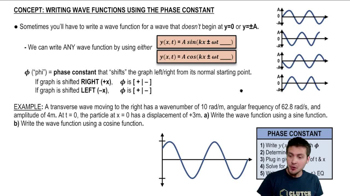
The phase constant, denoted as ϕ, is a parameter in the equations of SHM that determines the initial position of the oscillating object at time t = 0. It shifts the sine or cosine function along the time axis, allowing for the description of various starting conditions. In this problem, finding the phase constant is essential to accurately describe the motion of the mass when it is at a specific position, such as x = -1/2 A.
Video consigliato:
Percorso guidato
08:59
Phase Constant of a Wave Function