
Ch. 15 - Wave Motion
Giancoli Douglas - Physics for Scientists and Engineers 5th edition
Giancoli Douglas5th editionPhysics for Scientists and EngineersISBN: 9780137488179Non è quello che usi tu?Cambia libro di testo
Capitolo 15, Problema 66a

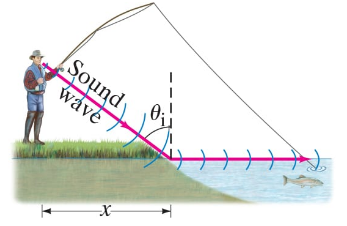
(II) For any type of wave that reaches a boundary beyond which its speed is increased, there is a maximum incident angle if there is to be a transmitted refracted wave. This maximum incident angle θiM corresponds to an angle of refraction equal to 90°. If θᵢ > θiM, all the wave is reflected at the boundary and none is refracted, because this would correspond to sin θᵣ > 1 (where is the angle θᵣ of refraction), which is impossible.
(a) Find a formula for θiM using the law of refraction, Eq. 15–19.

Guida verificata passo dopo passo
1
Step 1: Recall the law of refraction, also known as Snell's Law, which is expressed as: n1sinθi=n2sinθr. Here, n1 and n2 are the indices of refraction for the two media, θi is the angle of incidence, and θr is the angle of refraction.
Step 2: Recognize that the maximum incident angle θiM occurs when the angle of refraction θr is equal to 90°. Substitute θr = 90° into Snell's Law.
Step 3: Since sin(90) is equal to 1, Snell's Law simplifies to: n1sinθiM=n2. Rearrange this equation to solve for θiM.
Step 4: Divide both sides of the equation by n1 to isolate sinθiM: sinθiM=n2n1.
Step 5: To find the maximum incident angle θiM, take the inverse sine (arcsin) of both sides: θiM=arcsin(n2n1). This is the formula for the maximum incident angle.

Risposta video verificata per un problema simile:

Questa soluzione video è stata consigliata dai nostri tutor come utile per risolvere questo problema.
Durata del video:
2m

Concetti chiave

Ecco i concetti essenziali che devi comprendere per rispondere correttamente alla domanda.

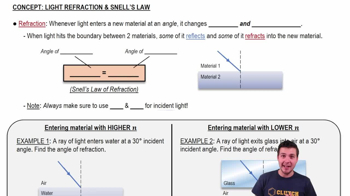
Law of Refraction (Snell's Law)

The Law of Refraction, also known as Snell's Law, describes how waves change direction when they pass from one medium to another. It is mathematically expressed as n₁ sin(θᵢ) = n₂ sin(θᵣ), where n₁ and n₂ are the refractive indices of the two media, and θᵢ and θᵣ are the angles of incidence and refraction, respectively. This law is fundamental in understanding how light and other waves behave at boundaries.
Video consigliato:

Critical Angle

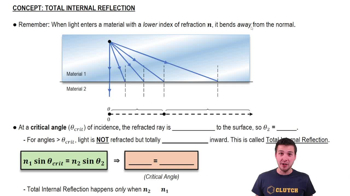
The critical angle is the angle of incidence above which total internal reflection occurs, meaning that all the incident wave is reflected back into the original medium. It is defined as θ_c = arcsin(n₂/n₁) when n₁ > n₂. When the angle of incidence exceeds this critical angle, the refracted wave cannot exist, leading to the phenomenon described in the question.
Video consigliato:

Total Internal Reflection

Total internal reflection is a phenomenon that occurs when a wave traveling in a medium hits a boundary with a less dense medium at an angle greater than the critical angle. In this case, the wave is completely reflected back into the original medium, and no refraction occurs. This principle is crucial in applications such as fiber optics, where light is kept within the fiber by repeated total internal reflections.
Video consigliato:
Percorso guidato
05:29
Total Internal Reflection