
Ch. 15 - Wave Motion
Giancoli Douglas - Physics for Scientists and Engineers 5th edition
Giancoli Douglas5th editionPhysics for Scientists and EngineersISBN: 9780137488179Non è quello che usi tu?Cambia libro di testo
Capitolo 15, Problema 55a

The displacement of a standing wave on a string is given by D = 2.4 sin ( 0.60x ) cos (42t) , where x and D are in centimeters and t is in seconds. What is the distance (cm) between nodes?

Guida verificata passo dopo passo
1
The equation of the standing wave is given as \( D = 2.4 \sin(0.60x) \cos(42t) \). In this equation, \( \sin(0.60x) \) represents the spatial part of the wave, and \( \cos(42t) \) represents the time-dependent part. Nodes occur where the displacement \( D \) is always zero, regardless of time.
To find the nodes, focus on the spatial part of the wave, \( \sin(0.60x) \). Nodes occur when \( \sin(0.60x) = 0 \). The sine function equals zero at integer multiples of \( \pi \), so \( 0.60x = n\pi \), where \( n \) is an integer (\( n = 0, \pm 1, \pm 2, \dots \)).
Solve for \( x \) to find the positions of the nodes: \( x = \frac{n\pi}{0.60} \). This gives the positions of the nodes along the string.
The distance between two consecutive nodes is the wavelength divided by 2. The wavelength \( \lambda \) is related to the wave number \( k \) by \( k = \frac{2\pi}{\lambda} \). From the equation \( \sin(0.60x) \), the wave number \( k \) is \( 0.60 \), so \( \lambda = \frac{2\pi}{0.60} \).
Finally, calculate the distance between nodes as \( \frac{\lambda}{2} = \frac{1}{2} \cdot \frac{2\pi}{0.60} \). This gives the distance between consecutive nodes in centimeters.

Risposta video verificata per un problema simile:

Questa soluzione video è stata consigliata dai nostri tutor come utile per risolvere questo problema.
Durata del video:
3m

Concetti chiave

Ecco i concetti essenziali che devi comprendere per rispondere correttamente alla domanda.

Standing Waves

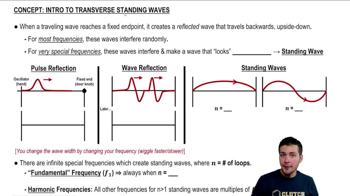
Standing waves are formed when two waves of the same frequency and amplitude travel in opposite directions and interfere with each other. This results in a wave pattern that appears to be stationary, characterized by fixed points called nodes (points of no displacement) and antinodes (points of maximum displacement). Understanding standing waves is crucial for analyzing wave behavior in strings and other mediums.
Video consigliato:
Percorso guidato
07:58
Intro to Transverse Standing Waves

Nodes and Antinodes

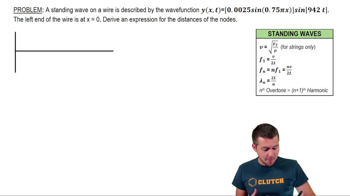
Nodes are specific points along a standing wave where the displacement is always zero, while antinodes are points where the displacement reaches its maximum. The distance between two consecutive nodes is half the wavelength of the wave. Identifying these points is essential for solving problems related to wave patterns and their properties.
Video consigliato:

Wavelength

Wavelength is the distance between two consecutive points that are in phase on a wave, such as from one node to the next node. In the context of standing waves, the wavelength can be determined from the wave equation. For the given equation, the spatial component (0.60x) indicates the wave number, which can be used to calculate the wavelength and subsequently the distance between nodes.
Video consigliato:
Percorso guidato
05:42
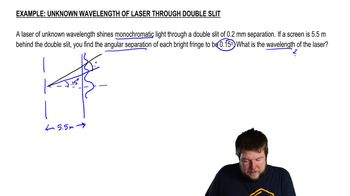
Unknown Wavelength of Laser through Double Slit