Ch. 15 - Wave Motion
Giancoli Douglas - Physics for Scientists and Engineers 5th edition
Giancoli Douglas5th editionPhysics for Scientists and EngineersISBN: 9780137488179Non è quello che usi tu?Cambia libro di testo
Capitolo 15, Problema 17a

What is the ratio of the intensities, of an earthquake P wave passing through the Earth and detected at two points 15 km and 55 km from the source?

Guida verificata passo dopo passo
1
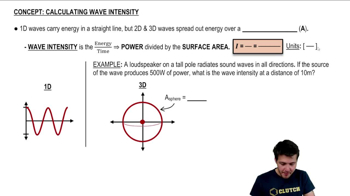
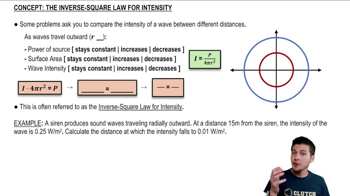
Understand that the intensity of a wave decreases as it propagates through a medium. For a spherical wave, the intensity is inversely proportional to the square of the distance from the source. This relationship can be expressed as \( I \propto \frac{1}{r^2} \), where \( I \) is the intensity and \( r \) is the distance from the source.
To find the ratio of intensities at two distances, \( r_1 \) and \( r_2 \), use the formula: \( \frac{I_1}{I_2} = \frac{r_2^2}{r_1^2} \). Here, \( I_1 \) and \( I_2 \) are the intensities at distances \( r_1 \) and \( r_2 \), respectively.
Substitute the given distances into the formula. Let \( r_1 = 15 \ \text{km} \) and \( r_2 = 55 \ \text{km} \). The ratio becomes \( \frac{I_1}{I_2} = \frac{55^2}{15^2} \).
Simplify the expression for the ratio by calculating the squares of the distances: \( \frac{I_1}{I_2} = \frac{3025}{225} \).
Conclude that the ratio of the intensities is determined by dividing the two values obtained in the previous step. This gives the final ratio of intensities at the two points.

Risposta video verificata per un problema simile:

Questa soluzione video è stata consigliata dai nostri tutor come utile per risolvere questo problema.
Durata del video:
4m

Concetti chiave

Ecco i concetti essenziali che devi comprendere per rispondere correttamente alla domanda.

P Waves

P waves, or primary waves, are a type of seismic wave that compress and expand the material they travel through. They are the fastest seismic waves and can move through solids, liquids, and gases. Understanding P waves is crucial for analyzing how seismic energy propagates through the Earth and how it is detected at various distances from the source.
Video consigliato:

Intensity of Seismic Waves

The intensity of seismic waves refers to the energy carried by the waves as they travel through the Earth. It is typically measured in terms of amplitude and is influenced by the distance from the source, the medium through which the waves travel, and the wave type. The intensity decreases with distance, which is essential for calculating the ratio of intensities at different points from the earthquake source.
Video consigliato:

Inverse Square Law

The inverse square law states that the intensity of a physical quantity (like light or seismic waves) decreases with the square of the distance from the source. This principle is fundamental in understanding how the intensity of seismic waves diminishes as they propagate through the Earth, allowing for the calculation of intensity ratios at different distances from the earthquake's epicenter.
Video consigliato:
Percorso guidato
05:26
The Inverse-Square Law for Intensity
Pratica correlata
Domanda del libro di testo

Two earthquake waves of the same frequency travel through the same portion of the Earth, but one is carrying 3.5 times the energy. What is the ratio of the amplitudes of the two waves?

1364
views

Domanda del libro di testo

Consider the point x = 1.00 m on the cord of Example 15–6. Determine the maximum acceleration of this point.

1369
views
Domanda del libro di testo

A sailor strikes the side of his ship just below the surface of the sea. He hears the echo of the wave reflected from the ocean floor directly below 2.4 s later. How deep is the ocean at this point? (Use Tables 12–1 and 13–1.)

812
views
Domanda del libro di testo

A transverse wave with a frequency of 220 Hz and a wavelength of 10.0 cm is traveling along a cord. The maximum speed of particles on the cord is 0.10 the wave speed. What is the amplitude of the wave?

1672
views
Domanda del libro di testo

A ski gondola [pronounced gon–do–la] is connected to the top of a hill by a steel cable of length 710 m and diameter 1.5 cm. As the gondola comes to the end of its run, it bumps into the terminal and sends a transverse wave pulse along the cable. It is observed that it took 17 s for the pulse to return. What is the tension in the cable?

1062
views
Domanda del libro di testo

A transverse wave pulse travels to the right along a string with a speed v = 2.0 m/s. At the shape of the pulse is given by the function D = 0.45 cos (2.6x + 1.2), where D and x are in meters. Determine a formula for the wave pulse at any time t assuming there are no frictional losses.

1337
views