
Ch. 16 - Sound
Giancoli Douglas - Physics for Scientists and Engineers 5th edition
Giancoli Douglas5th editionPhysics for Scientists and EngineersISBN: 9780137488179Non è quello che usi tu?Cambia libro di testo
Capitolo 16, Problema 49

A guitar string produces 3 beat/s when sounded with a 350-Hz tuning fork and 8 beat/s when sounded with a 355-Hz tuning fork. What is the vibrational frequency of the string? Explain your reasoning.

Guida verificata passo dopo passo
1
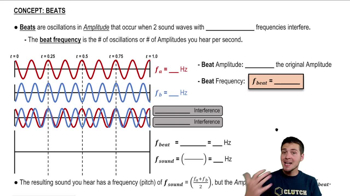
The phenomenon of beats occurs when two sound waves of slightly different frequencies interfere with each other. The beat frequency is equal to the absolute difference between the two frequencies: \( f_{\text{beat}} = |f_1 - f_2| \).
From the problem, the guitar string produces 3 beats per second with a 350-Hz tuning fork. This means the string's frequency \( f_s \) could either be \( 350 + 3 = 353 \, \text{Hz} \) or \( 350 - 3 = 347 \, \text{Hz} \).
Similarly, the string produces 8 beats per second with a 355-Hz tuning fork. This means the string's frequency \( f_s \) could either be \( 355 + 8 = 363 \, \text{Hz} \) or \( 355 - 8 = 347 \, \text{Hz} \).
To determine the correct frequency, compare the possible values from both cases. The only frequency that satisfies both conditions is \( f_s = 347 \; \text{Hz} \), as it produces 3 beats with 350 Hz and 8 beats with 355 Hz.
Thus, the vibrational frequency of the guitar string is \( f_s = 347 \; \text{Hz} \). This reasoning is based on the principle of beat frequency and the consistency of the results across both tuning forks.

Risposta video verificata per un problema simile:

Questa soluzione video è stata consigliata dai nostri tutor come utile per risolvere questo problema.
Durata del video:
3m

Concetti chiave

Ecco i concetti essenziali che devi comprendere per rispondere correttamente alla domanda.

Beats Frequency

Beats frequency occurs when two sound waves of slightly different frequencies interfere with each other, resulting in a periodic variation in amplitude. The beat frequency is equal to the absolute difference between the two frequencies. In this case, the guitar string's frequency can be determined by analyzing the beat frequencies produced with the tuning forks.
Video consigliato:

Frequency of Sound Waves

Frequency, measured in Hertz (Hz), refers to the number of cycles of a wave that occur in one second. In the context of sound, it determines the pitch of the sound produced. The guitar string's frequency must be calculated based on the known frequencies of the tuning forks and the observed beat frequencies.
Video consigliato:
Percorso guidato
05:17
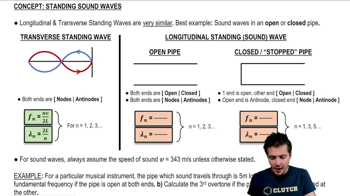
Standing Sound Waves

Interference of Waves

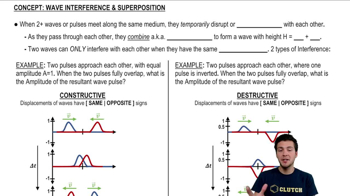
Interference occurs when two or more waves overlap, leading to a new wave pattern. Constructive interference amplifies the sound, while destructive interference diminishes it. Understanding how the guitar string interacts with the tuning forks through interference is crucial for determining its vibrational frequency based on the beat frequencies observed.
Video consigliato:
Percorso guidato
03:47
Wave Interference & Superposition