Ch. 17 - Temperature, Thermal Expansion, and the Ideal Gas Law
Giancoli Douglas - Physics for Scientists and Engineers 5th edition
Giancoli Douglas5th editionPhysics for Scientists and EngineersISBN: 9780137488179Non è quello che usi tu?Cambia libro di testo
Capitolo 17, Problema 9

The Eiffel Tower (Fig. 17–20) is built of wrought iron approximately 300 m tall. Estimate how much its height changes between January (average temperature of 2°C) and July (average temperature of 25°C). Ignore the angles of the iron beams and treat the tower as a vertical beam.
<IMAGE>

Guida verificata passo dopo passo
1
Determine the formula for linear thermal expansion: ΔL = α × L₀ × ΔT, where ΔL is the change in length, α is the coefficient of linear expansion for the material (wrought iron in this case), L₀ is the original length (height of the Eiffel Tower), and ΔT is the change in temperature.
Identify the given values: L₀ = 300 m (height of the Eiffel Tower), ΔT = 25°C - 2°C = 23°C (temperature difference between July and January), and α (coefficient of linear expansion for wrought iron, typically around 12 × 10⁻⁶ /°C).
Substitute the known values into the formula: ΔL = (12 × 10⁻⁶ /°C) × (300 m) × (23°C).
Simplify the expression to calculate the change in height, ΔL. Ensure the units are consistent throughout the calculation.
Interpret the result: The calculated ΔL represents the approximate change in the height of the Eiffel Tower due to thermal expansion between January and July.

Risposta video verificata per un problema simile:

Questa soluzione video è stata consigliata dai nostri tutor come utile per risolvere questo problema.
Durata del video:
5m

Concetti chiave

Ecco i concetti essenziali che devi comprendere per rispondere correttamente alla domanda.

Thermal Expansion

Thermal expansion refers to the tendency of materials to change in size or volume in response to changes in temperature. As temperature increases, the kinetic energy of the atoms in a material increases, causing them to move apart and the material to expand. This concept is crucial for understanding how structures like the Eiffel Tower can change height with seasonal temperature variations.
Video consigliato:
Percorso guidato
05:21
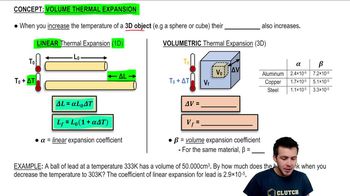
Volume Thermal Expansion

Linear Expansion Formula

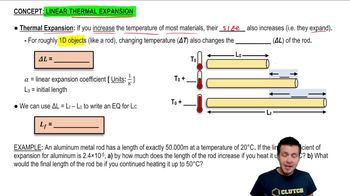
The linear expansion formula quantifies how much a material expands or contracts with temperature changes. It is expressed as ΔL = αL₀ΔT, where ΔL is the change in length, α is the coefficient of linear expansion, L₀ is the original length, and ΔT is the change in temperature. This formula allows us to calculate the height change of the Eiffel Tower based on its material properties and the temperature difference.
Video consigliato:
Percorso guidato
07:31
Linear Thermal Expansion

Coefficient of Linear Expansion

The coefficient of linear expansion (α) is a material-specific constant that indicates how much a unit length of a material expands per degree change in temperature. For wrought iron, this value is typically around 11 x 10⁻⁶ /°C. Knowing this coefficient is essential for accurately estimating the height change of the Eiffel Tower as it directly influences the calculations based on temperature variations.
Video consigliato:
Percorso guidato
07:31
Linear Thermal Expansion