
Ch. 17 - Temperature, Thermal Expansion, and the Ideal Gas Law
Giancoli Douglas - Physics for Scientists and Engineers 5th edition
Giancoli Douglas5th editionPhysics for Scientists and EngineersISBN: 9780137488179Non è quello che usi tu?Cambia libro di testo
Capitolo 17, Problema 43

A sealed metal container contains a gas at 30.0°C and absolute pressure 1.00 atm. To what temperature must the gas be heated for the pressure to double to 2.00 atm? (Ignore expansion of the container.)

Guida verificata passo dopo passo
1
Start by identifying the relationship between pressure and temperature for a gas in a sealed container. Since the volume and the amount of gas remain constant, we can use the Gay-Lussac's Law: PT = P1T1, where P is pressure and T is temperature in Kelvin.
Rearrange the formula to solve for the final temperature T2: T2 = P2T1 / P1.
Convert the initial temperature from Celsius to Kelvin, since the gas law requires temperatures in Kelvin. Use the formula: T1 = TC + 273.15. For TC = 30.0, calculate T1.
Substitute the known values into the rearranged formula: T2 = P2T1 / P1, where P1 = 1.00 atm, P2 = 2.00 atm, and T1 is the temperature in Kelvin from the previous step.
After calculating T2 in Kelvin, if needed, convert it back to Celsius using the formula: TC = TK - 273.15. This will give the final temperature in Celsius.

Risposta video verificata per un problema simile:

Questa soluzione video è stata consigliata dai nostri tutor come utile per risolvere questo problema.
Durata del video:
6m

Concetti chiave

Ecco i concetti essenziali che devi comprendere per rispondere correttamente alla domanda.

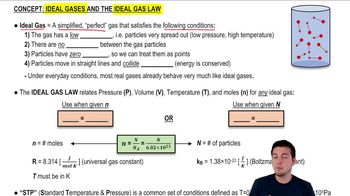
Ideal Gas Law

The Ideal Gas Law relates the pressure, volume, temperature, and number of moles of a gas through the equation PV = nRT. In this context, it helps us understand how changes in temperature affect pressure when the volume and amount of gas remain constant.
Video consigliato:
Percorso guidato
07:21
Ideal Gases and the Ideal Gas Law

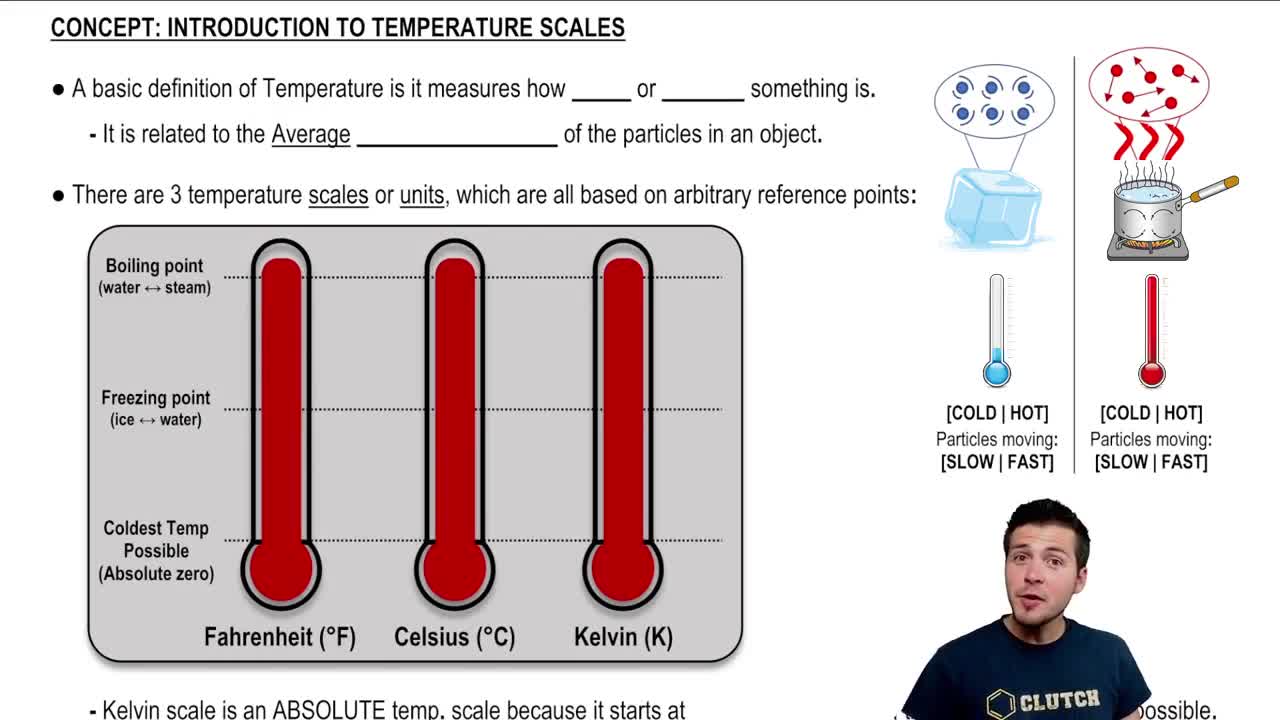
Absolute Temperature

Absolute temperature is measured in Kelvin and is crucial for gas law calculations. It is obtained by adding 273.15 to the Celsius temperature. Since gas laws require temperature in absolute terms, converting Celsius to Kelvin is essential for accurate results.
Video consigliato:
Percorso guidato
04:54
Introduction To Temperature Scales

Charles's Law

Charles's Law states that the volume of a gas is directly proportional to its absolute temperature when pressure is held constant. Although this problem involves pressure changes, understanding this law helps in grasping the relationship between temperature and pressure in gas behavior.
Video consigliato: