
Ch. 17 - Temperature, Thermal Expansion, and the Ideal Gas Law
Giancoli Douglas - Physics for Scientists and Engineers 5th edition
Giancoli Douglas5th editionPhysics for Scientists and EngineersISBN: 9780137488179Non è quello che usi tu?Cambia libro di testo
Capitolo 17, Problema 16a

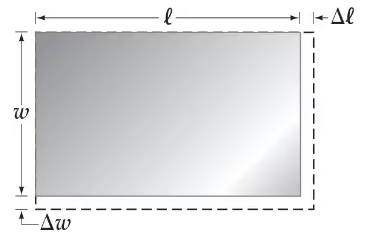
A uniform rectangular plate of length ℓ and width ω has a coefficient of linear expansion α. Show that, if we neglect very small quantities, the change in area of the plate due to a temperature change ∆T is ∆A = 2αℓω ∆T. See Fig. 17–21.
Diagram of a rectangular plate labeled with length ℓ, width w, and changes in dimensions Δℓ and Δw due to thermal expansion.

Guida verificata passo dopo passo
1
Start by recalling the formula for linear expansion: the change in length of an object due to a temperature change is given by Δℓ = αℓΔT, where α is the coefficient of linear expansion, ℓ is the original length, and ΔT is the temperature change.
For a rectangular plate, the area A is given by A = ℓω, where ℓ is the length and ω is the width. When the temperature changes, both the length and width expand linearly.
The new length of the plate after expansion is ℓ + Δℓ = ℓ + αℓΔT, and the new width is ω + Δω = ω + αωΔT. The new area of the plate is therefore (ℓ + αℓΔT)(ω + αωΔT).
Expand the expression for the new area: (ℓ + αℓΔT)(ω + αωΔT) = ℓω + ℓ(αωΔT) + ω(αℓΔT) + (αℓΔT)(αωΔT). The term (αℓΔT)(αωΔT) is very small compared to the other terms and can be neglected.
Simplify the expression: The change in area ΔA = (new area) - (original area) = [ℓω + ℓ(αωΔT) + ω(αℓΔT)] - ℓω = 2αℓωΔT. This shows that the change in area is proportional to the coefficient of linear expansion, the original area, and the temperature change.

Risposta video verificata per un problema simile:

Questa soluzione video è stata consigliata dai nostri tutor come utile per risolvere questo problema.
Durata del video:
5m

Concetti chiave

Ecco i concetti essenziali che devi comprendere per rispondere correttamente alla domanda.

Coefficient of Linear Expansion

The coefficient of linear expansion (α) quantifies how much a material expands per unit length for each degree of temperature increase. It is a crucial property in understanding how solids respond to temperature changes, as it directly influences the change in dimensions of an object, such as length and width.
Video consigliato:
Percorso guidato
07:31
Linear Thermal Expansion

Area Expansion

Area expansion refers to the increase in surface area of a two-dimensional object when subjected to a temperature change. For a rectangular plate, the change in area (∆A) can be derived from the linear expansions of its length and width, leading to the formula ∆A = 2αℓω∆T, which accounts for the contributions from both dimensions.
Video consigliato:
Percorso guidato
05:21
Volume Thermal Expansion

Temperature Change (∆T)

Temperature change (∆T) is the difference in temperature that causes materials to expand or contract. In the context of thermal expansion, it is essential to determine how much a material will change in size, as the extent of expansion is directly proportional to this temperature difference, influencing the overall change in area of the plate.
Video consigliato:
Percorso guidato
06:50
Specific Heat & Temperature Changes
Pratica correlata
Domanda del libro di testo

A brass plug is to be placed in a ring made of iron. At 15°C, the diameter of the plug is 8.756 cm and that of the inside of the ring is 8.742 cm. They must both be brought to what common temperature in order to fit?

1411
views
Domanda del libro di testo

It is observed that 55.50 mL of water at 20°C completely fills a container to the brim. When the container and the water are heated to 60°C, 0.35 g of water is lost.

(a) What is the coefficient of volume expansion of the container?

(b) What is the most likely material of the container? Density of water at 60°C is 0.98324 g/mL.

1019
views
Domanda del libro di testo

A glass is filled to the brim with 450.0 mL of water, all at 100.0°C. If the temperature of glass and water is decreased to 20.0°C, how much water could be added to the glass?

977
views
Domanda del libro di testo

The density of water at 4°C is 1.00 x 10³ kg / m³. What is water’s density at 94°C? Assume a constant coefficient of volume expansion.

1522
views
Domanda del libro di testo

At a given latitude, ocean water in the so-called mixed layer (from the surface to a depth of about 50 m) is at approximately the same temperature due to the mixing action of waves. Assume that because of global warming, the temperature of the mixed layer is everywhere increased by 0.5°C, while the temperature of the deeper portions of the ocean remains unchanged. Estimate the resulting rise in sea level. The ocean covers about 70% of the Earth’s surface.

983
views
Domanda del libro di testo

An aluminum sphere is 8.75 cm in diameter. What will be its % change in volume if it is heated from 30°C to 140°C?

1090
views