
Ch. 17 - Temperature, Thermal Expansion, and the Ideal Gas Law
Giancoli Douglas - Physics for Scientists and Engineers 5th edition
Giancoli Douglas5th editionPhysics for Scientists and EngineersISBN: 9780137488179Non è quello che usi tu?Cambia libro di testo
Capitolo 17, Problema 21

If a fluid is contained in a long narrow vessel so it can expand in essentially one direction only, show that the effective coefficient of linear expansion α is approximately equal to the coefficient of volume expansion β.

Guida verificata passo dopo passo
1
Start by recalling the definitions of the coefficients of linear expansion (α) and volume expansion (β). The coefficient of linear expansion (α) describes how the length of a material changes with temperature, while the coefficient of volume expansion (β) describes how the volume of a material changes with temperature.
For a long narrow vessel, assume the fluid expands primarily in one direction (let's call it the x-direction). The volume of the fluid can be expressed as \( V = A \cdot L \), where \( A \) is the cross-sectional area and \( L \) is the length of the vessel.
When the temperature changes, the volume expansion can be expressed as \( \Delta V = \beta V \Delta T \), where \( \beta \) is the coefficient of volume expansion and \( \Delta T \) is the temperature change. Substituting \( V = A \cdot L \), we get \( \Delta V = \beta (A \cdot L) \Delta T \).
Now consider the linear expansion of the vessel. The length \( L \) changes according to \( \Delta L = \alpha L \Delta T \), where \( \alpha \) is the coefficient of linear expansion. Since the fluid expands primarily in one direction, the change in volume is approximately due to the change in length, so \( \Delta V \approx A \cdot \Delta L \).
Substitute \( \Delta L = \alpha L \Delta T \) into \( \Delta V \approx A \cdot \Delta L \), giving \( \Delta V \approx A \cdot (\alpha L \Delta T) \). Comparing this with \( \Delta V = \beta (A \cdot L) \Delta T \), we see that \( \alpha \approx \beta \), as the cross-sectional area \( A \) and length \( L \) cancel out.

Risposta video verificata per un problema simile:

Questa soluzione video è stata consigliata dai nostri tutor come utile per risolvere questo problema.
Durata del video:
3m

Concetti chiave

Ecco i concetti essenziali che devi comprendere per rispondere correttamente alla domanda.

Coefficient of Linear Expansion (α)

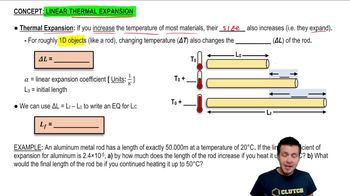
The coefficient of linear expansion (α) quantifies how much a material expands per unit length for each degree of temperature increase. It is defined as the change in length divided by the original length and the change in temperature. This concept is crucial for understanding how solids respond to temperature changes, particularly in one-dimensional expansion scenarios.
Video consigliato:
Percorso guidato
07:31
Linear Thermal Expansion

Coefficient of Volume Expansion (β)

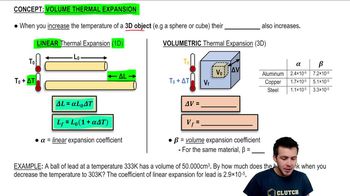
The coefficient of volume expansion (β) measures how much a material's volume changes per unit volume for each degree of temperature increase. It is defined as the change in volume divided by the original volume and the change in temperature. This concept is essential for analyzing how fluids behave under temperature variations, especially in confined spaces.
Video consigliato:
Percorso guidato
05:21
Volume Thermal Expansion

Relationship Between Linear and Volume Expansion

In three-dimensional objects, the relationship between linear expansion and volume expansion is given by the equation β = 3α for isotropic materials. This means that if a material expands uniformly in all directions, its volume change is three times the linear change. In the context of a fluid in a narrow vessel, the effective linear expansion can be approximated to equal the volume expansion due to the constraints of the vessel allowing expansion primarily in one direction.
Video consigliato:
Percorso guidato
05:21
Volume Thermal Expansion
Pratica correlata
Domanda del libro di testo

A brass plug is to be placed in a ring made of iron. At 15°C, the diameter of the plug is 8.756 cm and that of the inside of the ring is 8.742 cm. They must both be brought to what common temperature in order to fit?

1411
views
Domanda del libro di testo

It is observed that 55.50 mL of water at 20°C completely fills a container to the brim. When the container and the water are heated to 60°C, 0.35 g of water is lost.

(a) What is the coefficient of volume expansion of the container?

(b) What is the most likely material of the container? Density of water at 60°C is 0.98324 g/mL.

1019
views
Domanda del libro di testo

A glass is filled to the brim with 450.0 mL of water, all at 100.0°C. If the temperature of glass and water is decreased to 20.0°C, how much water could be added to the glass?

977
views
Domanda del libro di testo

Determine a formula for the change in surface area of a uniform solid sphere of radius r if its coefficient of linear expansion is α (assumed constant) and its temperature is changed by ∆T.

875
views
Domanda del libro di testo

The pendulum in a grandfather clock is made of brass and keeps perfect time at 17°C. How much time is gained or lost in a year if the clock is kept at 26°C? (Assume the frequency dependence on length for a simple pendulum applies; see Chapter 14.)

1112
views
Domanda del libro di testo

Wine bottles are never completely filled: a small volume of air is left in the glass bottle’s cylindrically shaped neck (inner diameter d = 18.5 mm) to allow for wine’s fairly large coefficient of thermal expansion. The distance H between the surface of the liquid contents and the bottom of the cork is called the “headspace height” (Fig. 17–22), and is typically H = 1.5 cm for a 750-mL bottle filled at 20°C. Due to its alcoholic content, wine’s coefficient of volume expansion is about double that of water; in comparison, the thermal expansion of glass can be neglected. Estimate H if the bottle is kept at 10°C.

1106
views