Ch. 18 - Kinetic Theory of Gases
Giancoli Douglas - Physics for Scientists and Engineers 5th edition
Giancoli Douglas5th editionPhysics for Scientists and EngineersISBN: 9780137488179Non è quello che usi tu?Cambia libro di testo
Capitolo 18, Problema 73b

A sample of cesium vapor is in an oven at 400°C. The volume of the oven is 75 cm³, the vapor pressure of Cs at 400°C is 17 mm-Hg, and the diameter of cesium atoms in the vapor is 0.33 nm. Determine the number of collisions a single Cs atom undergoes with other cesium atoms per second.

Guida verificata passo dopo passo
1
Convert the given vapor pressure of cesium from mm-Hg to Pascals (Pa) using the conversion factor: 1 mm-Hg = 133.322 Pa. This will allow us to work in SI units for pressure.
Calculate the number density of cesium atoms (n) using the ideal gas law: \( PV = Nk_BT \), where \( P \) is the pressure, \( V \) is the volume, \( N \) is the number of particles, \( k_B \) is the Boltzmann constant, and \( T \) is the temperature in Kelvin. Rearrange to find \( n = \frac{P}{k_B T} \).
Determine the mean free path (\( \lambda \)) of a cesium atom using the formula: \( \lambda = \frac{1}{\sqrt{2} \pi d^2 n} \), where \( d \) is the diameter of a cesium atom and \( n \) is the number density calculated in the previous step.
Calculate the average speed of a cesium atom (\( v_{avg} \)) using the formula: \( v_{avg} = \sqrt{\frac{8k_B T}{\pi m}} \), where \( m \) is the mass of a cesium atom, \( k_B \) is the Boltzmann constant, and \( T \) is the temperature in Kelvin.
Determine the collision frequency (\( f \)) for a single cesium atom using the formula: \( f = \frac{v_{avg}}{\lambda} \). This gives the number of collisions a single cesium atom undergoes per second.

Risposta video verificata per un problema simile:

Questa soluzione video è stata consigliata dai nostri tutor come utile per risolvere questo problema.
Durata del video:
9m

Concetti chiave

Ecco i concetti essenziali che devi comprendere per rispondere correttamente alla domanda.

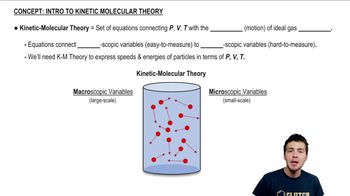
Kinetic Molecular Theory

Kinetic Molecular Theory explains the behavior of gases in terms of particles in constant motion. It posits that gas particles collide elastically with each other and the walls of their container, and that the temperature of the gas is directly related to the average kinetic energy of its particles. This theory is essential for understanding how cesium atoms interact in the vapor state.
Video consigliato:
Percorso guidato
01:50
Introduction to Kinetic-Molecular Theory

Collision Frequency

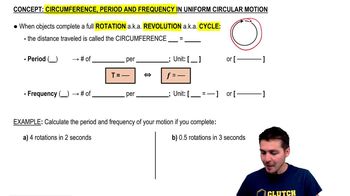
Collision frequency refers to the number of collisions that occur between particles in a given time frame. It is influenced by factors such as the density of the gas, the size of the particles, and their relative velocities. In this context, calculating the collision frequency of cesium atoms helps determine how often a single atom interacts with others in the vapor.
Video consigliato:
Percorso guidato
05:08
Circumference, Period, and Frequency in UCM

Ideal Gas Law

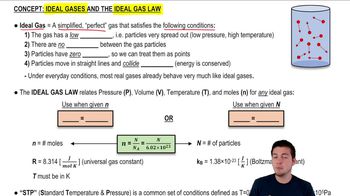
The Ideal Gas Law relates the pressure, volume, temperature, and number of moles of a gas through the equation PV = nRT. This law is fundamental in calculating the number of particles in a given volume of gas, which is necessary for determining the collision rate of cesium atoms in the vapor. Understanding this relationship allows for accurate predictions of gas behavior under specified conditions.
Video consigliato:
Percorso guidato
07:21
Ideal Gases and the Ideal Gas Law