
Ch. 18 - Kinetic Theory of Gases
Giancoli Douglas - Physics for Scientists and Engineers 5th edition
Giancoli Douglas5th editionPhysics for Scientists and EngineersISBN: 9780137488179Non è quello che usi tu?Cambia libro di testo
Capitolo 18, Problema 71

At room temperature, it takes approximately 2.45 x 10³ J to evaporate 1.00 g of water. Estimate the average speed of evaporating molecules. What multiple of vrms (at 20°C) for water molecules is this? (Assume Eq. 18–4 holds.)

Guida verificata passo dopo passo
1
Identify the given data: The energy required to evaporate 1.00 g of water is 2.45 × 10³ J. The mass of 1.00 g of water corresponds to 1.00 × 10⁻³ kg. The root-mean-square (rms) speed of water molecules at 20°C can be calculated using the formula for vᵣₘₛ: 3kT, where k is the Boltzmann constant and T is the temperature in kelvins.
Relate the energy required for evaporation to the kinetic energy of the molecules. The energy per molecule can be expressed as QN, where Q is the total energy (2.45 × 10³ J) and N is the number of molecules in 1.00 g of water. Use Avogadro's number and the molar mass of water (18.015 g/mol) to calculate N.
Calculate the average kinetic energy of a single molecule using the energy per molecule derived in the previous step. The kinetic energy is related to the speed of the molecule by the equation 12mv2, where m is the mass of a single water molecule and v is the average speed.
Solve for the average speed of the evaporating molecules using the equation v = 2E, where E is the average kinetic energy of a single molecule. Substitute the values for E and m to find v.
Compare the calculated average speed of the evaporating molecules to the root-mean-square speed (vᵣₘₛ) at 20°C. Use the ratio vvᵣₘₛ to determine the multiple of vᵣₘₛ that corresponds to the average speed of the evaporating molecules.

Risposta video verificata per un problema simile:

Questa soluzione video è stata consigliata dai nostri tutor come utile per risolvere questo problema.
Durata del video:
9m

Concetti chiave

Ecco i concetti essenziali che devi comprendere per rispondere correttamente alla domanda.

Latent Heat of Vaporization

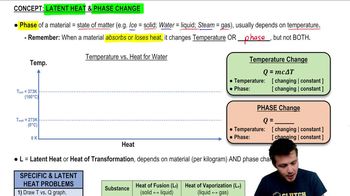
The latent heat of vaporization is the amount of energy required to convert a unit mass of a substance from liquid to gas at constant temperature. For water, this value is significant because it reflects the energy needed to overcome intermolecular forces during the phase change. In this question, the given energy of 2.45 x 10³ J is the latent heat needed to evaporate 1.00 g of water.
Video consigliato:
Percorso guidato
10:40
Latent Heat & Phase Changes

Average Speed of Molecules

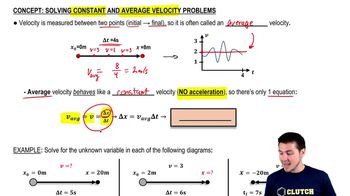
The average speed of molecules in a gas is related to their kinetic energy and temperature. At a given temperature, the average kinetic energy of gas molecules can be calculated using the equation KE = (3/2)kT, where k is the Boltzmann constant and T is the temperature in Kelvin. This concept is crucial for estimating the speed of evaporating water molecules, as it helps relate energy input to molecular motion.
Video consigliato:
Percorso guidato
05:44
Solving Constant and Average Velocity Problems

Root Mean Square Speed (vᵣₘₛ)

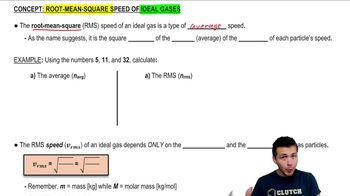
The root mean square speed (vᵣₘₛ) is a measure of the average speed of particles in a gas and is calculated using the formula vᵣₘₛ = √(3kT/m), where m is the mass of a molecule. This concept is important for comparing the speed of evaporating molecules to the average speed of water molecules at a specific temperature, allowing for a quantitative understanding of molecular dynamics during evaporation.
Video consigliato:
Percorso guidato
05:21
Root-Mean-Square Speed of Ideal Gases
Pratica correlata
Domanda del libro di testo

A space vehicle returning from the Moon enters the Earth’s atmosphere at a speed of about 42,000 km/h. Molecules (assume nitrogen) striking the nose of the vehicle with this speed correspond to what temperature? (Because of this high temperature, the nose of a space vehicle must be made of special materials; indeed, part of it does vaporize, and this is seen as a bright blaze upon reentry.)

1157
views
Domanda del libro di testo

From the van der Waals equation of state, show that the critical temperature and pressure are given by Tcr = 8a / 27bR , Pcr = a / 27b². [Hint: Use the fact that the P versus V curve has an inflection point at the critical point so that the first and second derivatives are zero.]

1262
views
Domanda del libro di testo

Using the ideal gas law, find an expression for the mean free path ℓM that involves pressure and temperature instead of (N/V). Use this expression to find the mean free path for nitrogen molecules at a pressure of 7.5 atm and 300 K.

1522
views
Domanda del libro di testo

A sauna has 7.8 m³ of air volume, and the temperature is 85°C. The air is perfectly dry. How much water (in kg) should be evaporated if we want to increase the relative humidity from 0% to 10%? (See Table 18–2.)

1522
views
Domanda del libro di testo

A sample of cesium vapor is in an oven at 400°C. The volume of the oven is 75 cm³, the vapor pressure of Cs at 400°C is 17 mm-Hg, and the diameter of cesium atoms in the vapor is 0.33 nm. Determine the number of collisions a single Cs atom undergoes with other cesium atoms per second.

1007
views
Domanda del libro di testo

Calculate the total water vapor pressure in the air on the following day: a hot summer day, with the temperature 30°C and the relative humidity at 75%.

1212
views