
Ch. 19 - Heat and the First Law of Thermodynamics
Giancoli Douglas - Physics for Scientists and Engineers 5th edition
Giancoli Douglas5th editionPhysics for Scientists and EngineersISBN: 9780137488179Non è quello che usi tu?Cambia libro di testo
Capitolo 19, Problema 100b

A 12-g lead bullet traveling at 220 m/s passes through a thin wall and emerges at a speed of 160 m/s. If the bullet absorbs 50% of the heat generated, If the bullet’s initial temperature was 20°C, will any of the bullet melt, and if so, how much?

Guida verificata passo dopo passo
1
Determine the kinetic energy lost by the bullet as it passes through the wall. Use the formula for kinetic energy: Ek = 12mv2, where m is the mass of the bullet and v is its velocity. Subtract the final kinetic energy from the initial kinetic energy to find the energy lost.
Calculate the heat energy absorbed by the bullet. Since the bullet absorbs 50% of the heat generated, multiply the energy lost by 0.5 to find the heat energy absorbed.
Determine the temperature increase of the bullet using the formula: Q = mcΔT, where Q is the heat energy absorbed, m is the mass of the bullet, c is the specific heat capacity of lead (128 J/kg°C), and ΔT is the temperature change. Solve for ΔT.
Check if the final temperature of the bullet exceeds the melting point of lead (327°C). Add the temperature increase to the initial temperature (20°C) to find the final temperature.
If the final temperature exceeds the melting point, calculate the amount of lead that melts using the formula: Q = mLf, where Lf is the latent heat of fusion for lead (24,500 J/kg). Subtract the heat required to raise the bullet to the melting point from the total heat absorbed, and use the remaining heat to calculate the mass of lead that melts.

Risposta video verificata per un problema simile:

Questa soluzione video è stata consigliata dai nostri tutor come utile per risolvere questo problema.
Durata del video:
10m

Concetti chiave

Ecco i concetti essenziali che devi comprendere per rispondere correttamente alla domanda.

Kinetic Energy

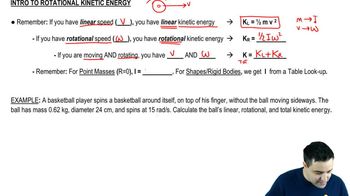
Kinetic energy is the energy possessed by an object due to its motion, calculated using the formula KE = 1/2 mv², where m is mass and v is velocity. In this scenario, the lead bullet's initial and final kinetic energies are crucial for determining the energy lost as it passes through the wall, which can then be related to the heat absorbed by the bullet.
Video consigliato:
Percorso guidato
06:07
Intro to Rotational Kinetic Energy

Heat Transfer

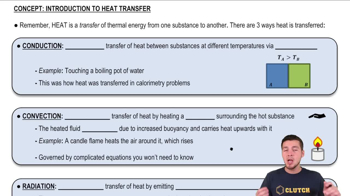
Heat transfer refers to the movement of thermal energy from one object or substance to another, which can occur through conduction, convection, or radiation. In this case, the bullet absorbs 50% of the heat generated from its kinetic energy loss, and understanding this concept is essential to calculate how much energy is converted to heat and whether it is sufficient to raise the bullet's temperature to its melting point.
Video consigliato:
Percorso guidato
05:14
Overview of Heat Transfer

Melting Point

The melting point is the temperature at which a solid becomes a liquid. For lead, this temperature is approximately 327.5°C. By calculating the temperature increase of the bullet after absorbing heat, we can determine if it reaches or exceeds this melting point, indicating whether any of the bullet will melt.
Video consigliato:
Percorso guidato
08:35
Angular Momentum of a Point Mass