
Ch. 19 - Heat and the First Law of Thermodynamics
Giancoli Douglas - Physics for Scientists and Engineers 5th edition
Giancoli Douglas5th editionPhysics for Scientists and EngineersISBN: 9780137488179Non è quello che usi tu?Cambia libro di testo
Capitolo 19, Problema 18

A 215-g sample of a substance is heated to 330°C and then plunged into a 105-g aluminum calorimeter cup containing 185 g of water and a 17-g glass thermometer at 10.5°C. The final temperature is 35.0°C. What is the specific heat of the substance? (Assume no water boils away.)

Guida verificata passo dopo passo
1
Convert all given masses to kilograms (kg) since the SI unit for mass is kilograms. For example, the mass of the substance is 215 g, which is equivalent to 0.215 kg.
Write the heat transfer equation for the system. The heat lost by the substance is equal to the heat gained by the aluminum calorimeter, water, and glass thermometer. Mathematically, this can be expressed as: Q_{substance} = Q_{aluminum} + Q_{water} + Q_{glass}.
Express the heat transfer for each component using the formula Q = mc\(\Delta\) T, where m is the mass, c is the specific heat capacity, and \(\Delta\) T is the temperature change. For the substance: Q_{substance} = m_{substance} c_{substance} (T_{initial,substance} - T_{final}). For aluminum: Q_{aluminum} = m_{aluminum} c_{aluminum} (T_{final} - T_{initial,aluminum}). Similarly, write expressions for water and glass.
Substitute the known values into the equations. Use the specific heat capacities: c_{aluminum} = 900 \ \(\text{J/kg·°C}\), c_{water} = 4186 \ \(\text{J/kg·°C}\), and c_{glass} = 840 \ \(\text{J/kg·°C}\). The initial and final temperatures are given in the problem.
Solve for the specific heat capacity of the substance, c_{substance}, by rearranging the equation: c_{substance} = \(\frac{Q_{aluminum}\) + Q_{water} + Q_{glass}}{m_{substance} (T_{initial,substance} - T_{final})}. Perform the algebraic simplifications to isolate c_{substance}.

Risposta video verificata per un problema simile:

Questa soluzione video è stata consigliata dai nostri tutor come utile per risolvere questo problema.
Durata del video:
9m

Concetti chiave

Ecco i concetti essenziali che devi comprendere per rispondere correttamente alla domanda.

Specific Heat Capacity

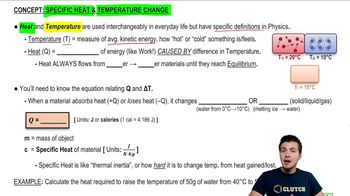
Specific heat capacity is the amount of heat required to raise the temperature of one gram of a substance by one degree Celsius. It is a material property that varies between different substances and is crucial for calculating heat transfer in thermal processes. The formula used is Q = mcΔT, where Q is the heat absorbed or released, m is the mass, c is the specific heat capacity, and ΔT is the change in temperature.
Video consigliato:
Percorso guidato
06:50
Specific Heat & Temperature Changes

Heat Transfer

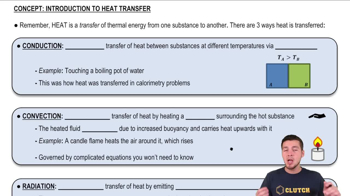
Heat transfer refers to the movement of thermal energy from one object or substance to another due to a temperature difference. In this scenario, heat is transferred from the heated substance to the cooler water, aluminum cup, and thermometer until thermal equilibrium is reached. Understanding the principles of heat transfer is essential for solving calorimetry problems, as it allows us to apply the conservation of energy.
Video consigliato:
Percorso guidato
05:14
Overview of Heat Transfer

Calorimetry

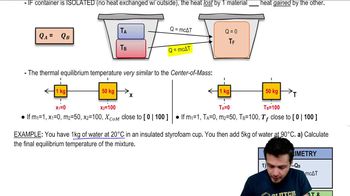
Calorimetry is the science of measuring the heat of chemical reactions or physical changes, as well as heat capacity. In this problem, a calorimeter is used to measure the heat exchange between the heated substance and the water, cup, and thermometer. By applying the principle of conservation of energy, where the heat lost by the substance equals the heat gained by the water and calorimeter, we can determine the specific heat of the unknown substance.
Video consigliato:
Percorso guidato
06:53
Solving Calorimetry Problems
Pratica correlata
Domanda del libro di testo

(II) A 0.40-kg iron horseshoe just forged and very hot (Fig. 19–31), is dropped into 1.35 L of water in a 0.30-kg iron pot initially at 20.0°C. If the final equilibrium temperature is 25.0°C, estimate the initial temperature of the hot horseshoe..

<IMAGE>

1374
views
Domanda del libro di testo

What is the specific heat of a metal substance if 165 kJ of heat is needed to raise 4.1 kg of the metal from 18.0°C to 37.2°C?

1066
views
Domanda del libro di testo

The heat capacity, C, of an object is defined as the amount of heat needed to raise its temperature by 1 °C. Thus, to raise the temperature by ∆T requires heat Q given by Q = C∆T. What is the heat capacity of 38 kg of water?

1229
views
Domanda del libro di testo

(a) How long does it take a 750-W coffeepot to bring to a boil 0.75 L of water at sea level initially at 11°C? Assume that the part of the pot which is heated with the water is made of 250 g of aluminum, and that no water boils away.

(b) For how long could this amount of energy run a 60-W lightbulb?

1339
views
Domanda del libro di testo

A 0.095-kg aluminum sphere is dropped from the roof of a 55-m-high building. If 65% of the thermal energy produced when it hits the ground is absorbed by the sphere, what is its temperature increase?

1217
views
Domanda del libro di testo

(II) A cube of ice is taken from the freezer at -8.5°C and placed in an 85-g aluminum calorimeter filled with 310 g of water at room temperature of 20.0°C. The final situation is all water at 17.0°C. What was the mass of the ice cube?

827
views