Ch. 19 - Heat and the First Law of Thermodynamics
Giancoli Douglas - Physics for Scientists and Engineers 5th edition
Giancoli Douglas5th editionPhysics for Scientists and EngineersISBN: 9780137488179Non è quello che usi tu?Cambia libro di testo
Capitolo 19, Problema 29

At a crime scene, the forensic investigator notes that the 6.2-g lead bullet that was stopped in a doorframe apparently melted completely on impact. Assuming the bullet was shot at room temperature (20°C), what does the investigator calculate as the minimum muzzle velocity of the gun?

Guida verificata passo dopo passo
1
Determine the total energy required to melt the bullet. This includes the energy needed to raise the temperature of the lead bullet from room temperature (20°C) to its melting point, and the energy required to melt it completely. Use the formula for heat transfer: Q = mcΔT for the temperature increase, and Q = mL for the phase change, where m is the mass, c is the specific heat capacity, ΔT is the temperature change, and L is the latent heat of fusion.
Look up the necessary physical constants for lead: specific heat capacity (c = 128 \, \(\text{J/kg·°C}\)), melting point (T_m = 327.5 \, \(\text{°C}\)), and latent heat of fusion (L = 2.45 \(\times\) 10^4 \, \(\text{J/kg}\)).
Calculate the energy required to raise the temperature of the bullet to its melting point using Q_1 = mcΔT, where ΔT = T_m - T_i (initial temperature is 20°C).
Calculate the energy required to melt the bullet completely using Q_2 = mL. Add Q_1 and Q_2 to find the total energy Q_{\(\text{total}\)} required to melt the bullet.
Relate the total energy to the kinetic energy of the bullet using the formula for kinetic energy: KE = \(\frac{1}{2}\)mv^2. Solve for the minimum muzzle velocity v by equating KE = Q_{\(\text{total}\)} and rearranging to find v = \(\sqrt{\frac{2Q_{\text{total}\)}}{m}}.

Risposta video verificata per un problema simile:

Questa soluzione video è stata consigliata dai nostri tutor come utile per risolvere questo problema.
Durata del video:
9m

Concetti chiave

Ecco i concetti essenziali che devi comprendere per rispondere correttamente alla domanda.

Kinetic Energy

Kinetic energy is the energy possessed by an object due to its motion, calculated using the formula KE = 1/2 mv², where m is mass and v is velocity. In this scenario, the kinetic energy of the bullet at the moment of impact is crucial for determining how much energy was available to cause the bullet to melt upon hitting the doorframe.
Video consigliato:
Percorso guidato
06:07
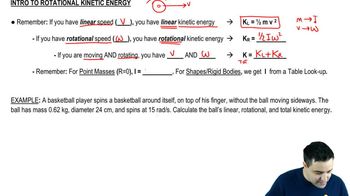
Intro to Rotational Kinetic Energy

Heat Transfer and Melting

Heat transfer refers to the movement of thermal energy from one object to another, which can occur through conduction, convection, or radiation. When the bullet strikes the doorframe, its kinetic energy is converted into thermal energy, raising the bullet's temperature to its melting point, which is essential for calculating the energy required for the bullet to melt.
Video consigliato:
Percorso guidato
05:14
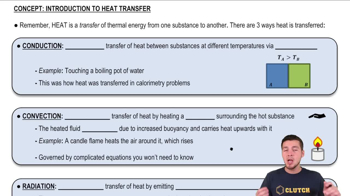
Overview of Heat Transfer

Conservation of Energy

The principle of conservation of energy states that energy cannot be created or destroyed, only transformed from one form to another. In this context, the kinetic energy of the bullet is transformed into thermal energy upon impact, and understanding this principle allows the investigator to relate the bullet's initial velocity to the energy needed for melting.
Video consigliato:
Percorso guidato
06:24
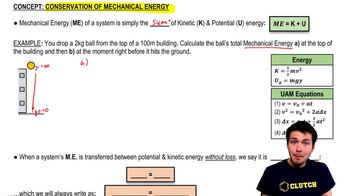
Conservation Of Mechanical Energy
Pratica correlata
Domanda del libro di testo

An iron boiler of mass 180 kg contains 710 kg of water at 18°C. A heater supplies energy at the rate of 58,000 kJ/h. How long does it take for the water to all have changed to steam?

656
views

Domanda del libro di testo

If a heater supplies 1.8 x 10⁶ J/h to a room 3.5 m x 4.6 m x 3.0 m containing air at 20°C and 1.0 atm, by how much will the temperature rise in one hour, assuming no losses of heat or air mass to the outside? Assume air is an ideal diatomic gas with molecular mass 29.

1142
views
Domanda del libro di testo

A 1.0-L volume of air initially at 3.5 atm of (gauge)pressure is allowed to expand isothermally until the (gauge) pressure is 1.0 atm. It is then compressed at constant pressure to its initial volume, and lastly is brought back to its original pressure by heating at constant volume. How much work does the 1.0 L of air do in this process?

1517
views
Domanda del libro di testo

Determine the latent heat of fusion of mercury using the following calorimeter data: 1.00 kg of solid Hg at its melting point of −39.0°C is placed in a 0.620-kg aluminum calorimeter with 0.400 kg of water at 12.80°C; the resulting equilibrium temperature is 5.06°C.

923
views
Domanda del libro di testo

High-altitude mountain climbers do not eat snow, but always melt it first with a stove. To see why, calculate the energy absorbed from your body if you melt 1.0 kg of -15°C snow using a stove and drink the resulting 1.0 kg of water at 2°C, which your body has to warm to 37°C.

543
views