
Ch. 20 - Second Law of Thermodynamics
Giancoli Douglas - Physics for Scientists and Engineers 5th edition
Giancoli Douglas5th editionPhysics for Scientists and EngineersISBN: 9780137488179Non è quello che usi tu?Cambia libro di testo
Capitolo 20, Problema 60a

Suppose that you repeatedly shake six coins in your hand and drop them on the floor. Construct a table showing the number of microstates that correspond to each macrostate. What is the probability of obtaining three heads and three tails?

Guida verificata passo dopo passo
1
Understand the problem: A macrostate is defined by the number of heads and tails (e.g., 3 heads and 3 tails), while a microstate is a specific arrangement of the coins (e.g., HHTTHT). The goal is to calculate the number of microstates for each macrostate and determine the probability of obtaining 3 heads and 3 tails.
Step 1: Use the binomial coefficient formula to calculate the number of microstates for each macrostate. The formula is: C(n,r)=n!r!(n-r)!, where n is the total number of coins (6 in this case) and r is the number of heads.
Step 2: Construct a table for all possible macrostates (0 heads, 1 head, ..., 6 heads). For each macrostate, calculate the number of microstates using the binomial coefficient formula. For example, for 3 heads and 3 tails, calculate: C(6,3)=6!3!(6-3)!.
Step 3: Calculate the total number of microstates by summing up the microstates for all macrostates. The total number of microstates is given by 26, since each coin has two possible outcomes (head or tail).
Step 4: Determine the probability of obtaining 3 heads and 3 tails. The probability is given by the ratio of the number of microstates for the desired macrostate (3 heads and 3 tails) to the total number of microstates. Use the formula: P=C(6,3)26.

Risposta video verificata per un problema simile:

Questa soluzione video è stata consigliata dai nostri tutor come utile per risolvere questo problema.
Durata del video:
6m

Concetti chiave

Ecco i concetti essenziali che devi comprendere per rispondere correttamente alla domanda.

Microstates and Macrostates

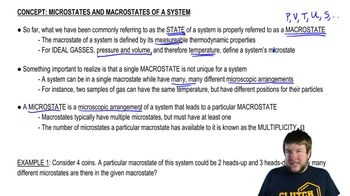
In statistical mechanics, a microstate refers to a specific detailed configuration of a system, while a macrostate is defined by macroscopic properties like temperature or pressure. For example, when flipping coins, each unique arrangement of heads and tails represents a microstate, whereas the overall count of heads and tails (e.g., three heads and three tails) represents a macrostate.
Video consigliato:
Percorso guidato
06:41
Microstates and Macrostates of a System

Combinatorics

Combinatorics is a branch of mathematics dealing with counting, arrangement, and combination of objects. In the context of the coin problem, it helps determine the number of ways to achieve a specific outcome, such as three heads and three tails, by using the binomial coefficient, which calculates the number of ways to choose a subset from a larger set.

Probability

Probability quantifies the likelihood of an event occurring, expressed as a ratio of favorable outcomes to the total number of possible outcomes. In this scenario, the probability of obtaining three heads and three tails can be calculated by dividing the number of favorable microstates (ways to achieve three heads and three tails) by the total number of microstates for six coin flips.
Video consigliato:
Percorso guidato
04:03
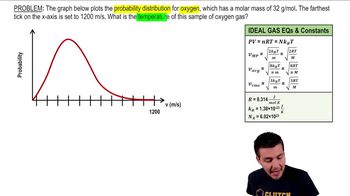
Probability Distribution Graph