Ch. 23 - Electric Potential
Giancoli Douglas - Physics for Scientists and Engineers 5th edition
Giancoli Douglas5th editionPhysics for Scientists and EngineersISBN: 9780137488179Non è quello che usi tu?Cambia libro di testo
Capitolo 22, Problema 52

A dust particle with mass of 0.050 g and a charge of 2.0 x 10⁻⁶ C is in a region of space where the potential is given by V(x) = (2.0 V/m²) x² - (3.0 V/m³)x³. If the particle starts at x = 2.5m, what is the initial acceleration of the charge?

Guida verificata passo dopo passo
1
Convert the mass of the dust particle from grams to kilograms, as the SI unit for mass is kilograms. Use the conversion factor: 1 g = 0.001 kg. Thus, the mass is m = 0.050 g × 0.001 kg/g.
Determine the electric field E(x) from the given potential function V(x). The electric field is the negative gradient of the potential: E(x) = -dV/dx. Differentiate V(x) = (2.0 V/m²)x² - (3.0 V/m³)x³ with respect to x.
Evaluate the electric field E(x) at the given position x = 2.5 m. Substitute x = 2.5 m into the expression for E(x) obtained in the previous step.
Calculate the force acting on the charged particle using the formula F = qE, where q is the charge of the particle (2.0 × 10⁻⁶ C) and E is the electric field at x = 2.5 m.
Determine the initial acceleration of the particle using Newton's second law, a = F/m, where F is the force calculated in the previous step and m is the mass of the particle in kilograms.

Risposta video verificata per un problema simile:

Questa soluzione video è stata consigliata dai nostri tutor come utile per risolvere questo problema.
Durata del video:
6m

Concetti chiave

Ecco i concetti essenziali che devi comprendere per rispondere correttamente alla domanda.

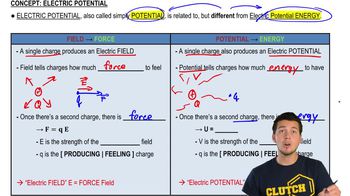
Electric Potential and Electric Field

Electric potential (V) is a measure of the potential energy per unit charge at a point in an electric field. The electric field (E) can be derived from the potential by taking the negative gradient, E = -dV/dx. In this case, the potential function V(x) is given, and understanding how to calculate the electric field from it is crucial for determining the force acting on the charged particle.
Video consigliato:
Percorso guidato
07:33
Electric Potential

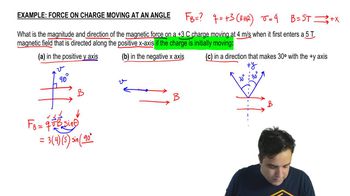
Force on a Charged Particle

The force (F) acting on a charged particle in an electric field is given by F = qE, where q is the charge of the particle and E is the electric field strength. This relationship is fundamental in physics as it allows us to calculate the force experienced by the particle due to the electric field, which is essential for finding its acceleration.
Video consigliato:
Percorso guidato
06:21
Force on Charge Moving at an Angle

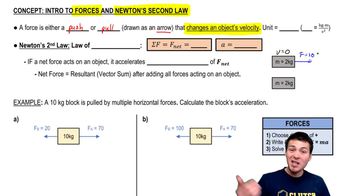
Newton's Second Law of Motion

Newton's Second Law states that the acceleration (a) of an object is directly proportional to the net force (F) acting on it and inversely proportional to its mass (m), expressed as F = ma. This principle is vital for calculating the acceleration of the dust particle once the force acting on it has been determined from the electric field.
Video consigliato:
Percorso guidato
06:54
Intro to Forces & Newton's Second Law