Ch. 25 - Electric Current and Resistance
Giancoli Douglas - Physics for Scientists and Engineers 5th edition
Giancoli Douglas5th editionPhysics for Scientists and EngineersISBN: 9780137488179Non è quello che usi tu?Cambia libro di testo
Capitolo 24, Problema 55b

A 0.65-mm-diameter copper wire carries a tiny current of 3.2 μA. Estimate the current density.

Guida verificata passo dopo passo
1
Determine the cross-sectional area of the copper wire. The wire is cylindrical, so the cross-sectional area can be calculated using the formula for the area of a circle: A=πr22, where r is the radius of the wire. Convert the diameter (0.65 mm) to meters and divide by 2 to find the radius.
Substitute the radius into the formula for the area to calculate the cross-sectional area. Ensure that the units are consistent (meters for the radius).
Recall the formula for current density: J=IA, where J is the current density, I is the current, and A is the cross-sectional area.
Substitute the given current (3.2 μA, converted to amperes) and the calculated cross-sectional area into the formula for current density.
Simplify the expression to find the current density. Ensure that the units are consistent, and express the result in standard units (A/m²).

Risposta video verificata per un problema simile:

Questa soluzione video è stata consigliata dai nostri tutor come utile per risolvere questo problema.
Durata del video:
2m

Concetti chiave

Ecco i concetti essenziali che devi comprendere per rispondere correttamente alla domanda.

Current Density

Current density is defined as the amount of electric current flowing per unit area of a conductor. It is represented by the symbol 'J' and is calculated using the formula J = I/A, where 'I' is the current in amperes and 'A' is the cross-sectional area in square meters. Understanding current density is crucial for analyzing how current distributes within a conductor.
Video consigliato:
Percorso guidato
8:13
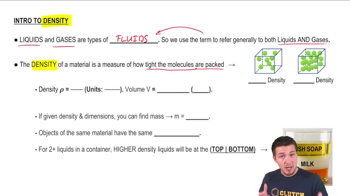
Intro to Density

Cross-Sectional Area

The cross-sectional area of a wire is the area of a slice taken perpendicular to its length. For a cylindrical wire, this area can be calculated using the formula A = π(d/2)², where 'd' is the diameter of the wire. This concept is essential for determining how much current flows through a given area, which directly affects the current density.
Video consigliato:
Percorso guidato
08:10
Calculating the Vector (Cross) Product Using Components

Ohm's Law

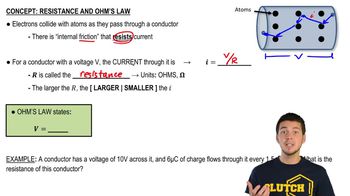
Ohm's Law states that the current flowing through a conductor between two points is directly proportional to the voltage across the two points and inversely proportional to the resistance of the conductor. It is expressed as V = IR, where 'V' is voltage, 'I' is current, and 'R' is resistance. This law helps in understanding the relationship between current, voltage, and resistance in electrical circuits.
Video consigliato:
Percorso guidato
03:07
Resistance and Ohm's Law