
Ch. 25 - Electric Current and Resistance
Giancoli Douglas - Physics for Scientists and Engineers 5th edition
Giancoli Douglas5th editionPhysics for Scientists and EngineersISBN: 9780137488179Non è quello che usi tu?Cambia libro di testo
Capitolo 24, Problema 41

(II) A power station delivers 750 kW of power at 12,000 V to a factory through wires with total resistance 3.0 Ω. How much less power is wasted if the electricity is delivered at 50,000 V rather than 12,000 V?

Guida verificata passo dopo passo
1
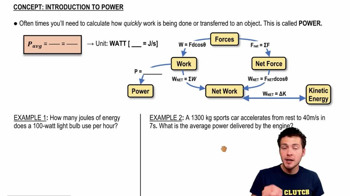
Step 1: Calculate the current (I) in the circuit when the power is delivered at 12,000 V. Use the formula for power: P=VI, where P is the power (750 kW) and V is the voltage (12,000 V). Rearrange to find I=P/V.
Step 2: Calculate the power wasted in the wires when the voltage is 12,000 V. Use the formula for power loss due to resistance: Ploss=I2R, where I is the current calculated in Step 1 and R is the total resistance of the wires (3.0 Ω).
Step 3: Repeat Step 1 to calculate the current (I) when the power is delivered at 50,000 V. Use the same formula: I=P/V, but substitute 50,000 V for the voltage.
Step 4: Calculate the power wasted in the wires when the voltage is 50,000 V. Again, use the formula Ploss=I2R, but use the current calculated in Step 3.
Step 5: Find the difference in power wasted between the two cases. Subtract the power loss at 50,000 V from the power loss at 12,000 V to determine how much less power is wasted when the electricity is delivered at the higher voltage.

Risposta video verificata per un problema simile:

Questa soluzione video è stata consigliata dai nostri tutor come utile per risolvere questo problema.
Durata del video:
8m

Concetti chiave

Ecco i concetti essenziali che devi comprendere per rispondere correttamente alla domanda.

Power and Voltage Relationship

The relationship between power (P), voltage (V), and current (I) is defined by the equation P = VI. This means that for a given power output, increasing the voltage allows for a decrease in current, which is crucial for minimizing energy losses in transmission lines.
Video consigliato:

Ohm's Law

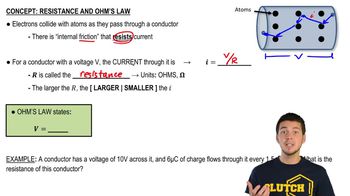
Ohm's Law states that the current (I) flowing through a conductor between two points is directly proportional to the voltage (V) across the two points and inversely proportional to the resistance (R) of the conductor, expressed as V = IR. This principle helps in understanding how resistance affects power loss in electrical systems.
Video consigliato:
Percorso guidato
03:07
Resistance and Ohm's Law

Power Loss in Transmission Lines

Power loss in transmission lines is primarily due to the resistance of the wires, calculated using the formula P_loss = I²R. As current increases, the power lost as heat in the wires also increases, making high-voltage transmission more efficient by reducing current and thus minimizing losses.
Video consigliato: