Ch. 28 - Sources of Magnetic Field
Giancoli Douglas - Physics for Scientists and Engineers 5th edition
Giancoli Douglas5th editionPhysics for Scientists and EngineersISBN: 9780137488179Non è quello che usi tu?Cambia libro di testo
Capitolo 27, Problema 38

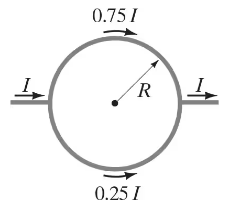
(II) A circular conducting ring of radius 𝑅 is connected to two exterior straight wires at two ends of a diameter (Fig. 28–47). The current I splits into unequal portions as shown (unequal resistance) while passing through the ring. What is B→\(\overrightarrow{B}\) at the center of the ring?


Guida verificata passo dopo passo
1
Understand the problem: The circular conducting ring has a current I flowing through it, splitting into unequal portions due to unequal resistance. We need to calculate the magnetic field B at the center of the ring caused by the current distribution.
Recall the Biot-Savart Law: The magnetic field at a point due to a current element is given by: B=μ0I4πdLrsinθ, where μ₀ is the permeability of free space, I is the current, dL is the length of the current element, r is the distance from the element to the point, and θ is the angle between dL and r.
Analyze the symmetry: The ring is circular, and the current flows through it symmetrically. At the center of the ring, contributions to the magnetic field from opposite sides of the ring will add up due to symmetry.
Set up the integral: To find the total magnetic field at the center, integrate the contributions from all current elements around the ring. The formula simplifies for a circular loop to: B=μ0I2R, where R is the radius of the ring.
Account for unequal current distribution: Since the current splits into unequal portions, calculate the magnetic field contributions from each segment separately using the Biot-Savart Law, and then sum them to find the net magnetic field at the center of the ring.

Risposta video verificata per un problema simile:

Questa soluzione video è stata consigliata dai nostri tutor come utile per risolvere questo problema.
Durata del video:
11m

Concetti chiave

Ecco i concetti essenziali che devi comprendere per rispondere correttamente alla domanda.

Magnetic Field Due to a Current-Carrying Loop

A circular conducting loop carrying a current generates a magnetic field in the space around it. The direction of the magnetic field at the center of the loop can be determined using the right-hand rule, where the thumb points in the direction of the current and the fingers curl in the direction of the magnetic field lines. The strength of the magnetic field at the center is given by the formula B = (μ₀I)/(2R), where μ₀ is the permeability of free space, I is the current, and R is the radius of the loop.

Current Division in Parallel Circuits

When a current splits between two or more paths in a circuit, the division of current depends on the resistance of each path. According to Ohm's law, the current through a resistor is inversely proportional to its resistance. In this scenario, the unequal resistances of the wires connected to the ring will cause the current to divide unevenly, affecting the total current flowing through the ring and consequently the magnetic field produced.

Superposition of Magnetic Fields

The principle of superposition states that the total magnetic field at a point due to multiple sources is the vector sum of the individual magnetic fields produced by each source. In this case, the magnetic field at the center of the ring will be influenced by the contributions from both the current in the ring and the currents in the exterior wires. Understanding how to calculate the resultant magnetic field from these contributions is essential for solving the problem.
Pratica correlata
Domanda del libro di testo

(III) Use the result of Problem 44 to find the magnetic field at point P in Fig. 28–53 due to the current in the square loop.


583
views

Domanda del libro di testo

(II) Two long parallel wires 8.20 cm apart carry 19.5-A dc currents in the same direction. Determine the magnetic field vector at a point P, 12.0 cm from one wire and 13.0 cm from the other. See Fig. 28–43. [Hint: Use the law of cosines. See Appendix A or inside rear cover.]

591
views
Domanda del libro di testo

(II) An electron enters a uniform magnetic field B = 0.28 T at a 45° angle to B→\(\overrightarrow{B}\). Determine the radius r and pitch p (distance between loops) of the electron’s helical path assuming its speed is 2.2 x 10⁶ m/s. See Fig. 27–48.


1226
views
Domanda del libro di testo

(II) Consider a straight section of wire of length d, as in Fig. 28–51, which carries a current I. (a) Show that the magnetic field at a point P a distance 𝑅 from the wire along its perpendicular bisector is


B=μ0I2πRd(d2+4R2)12B = \(\frac{\mu_0 I}{2\pi R}\) \(\frac{d}{(d^2 + 4R^2)^{\frac{1}{2}\)}}


(b) Show that this is consistent with Example 28–10 for an infinite wire.

646
views
Domanda del libro di testo

(II) A wire is formed into the shape of two half circles connected by equal-length straight sections as shown in Fig. 28–48. A current I flows in the circuit clockwise as shown. Determine (a) the magnitude and direction of the magnetic field at the center, C, and (b) the magnetic dipole moment of the circuit.

858
views
Domanda del libro di testo

(III) A coaxial cable consists of a solid inner conductor of radius R1, surrounded by a concentric cylindrical tube of inner radius R2 and outer radius R3 (Fig. 28–45). The conductors carry equal and opposite currents I₀ distributed uniformly across their cross sections. Determine the magnetic field at a distance R from the axis for: (a) R < R1; (b) R1 < R < R2; (c) R2 < R < R3; (d) R > R3. (e) Let I₀ = 1.50 A, R1 = 1.00 cm , R2 = 2.00 cm , and R3 = 2.50 cm Graph B from R = 0 to R = 3.00 cm.

994
views