
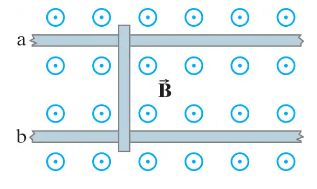

(III) Suppose a conducting rod (mass m, resistance R) rests on two frictionless and resistanceless parallel rails a distance ℓ apart in a uniform magnetic field (⊥ to the rails and to the rod) as in Fig. 29–53. At t = 0, the rod is at rest and a source of emf is connected to the points a and b. Determine the speed of the rod as a function of time if (a) the source puts out a constant current I, (b) the source puts out a constant emf ε₀. (c) Does the rod reach a terminal speed in either case? If so, what is it?
Ch. 29 - Electromagnetic Induction and Faraday's Law
Giancoli Douglas5th editionPhysics for Scientists and EngineersISBN: 9780137488179Non è quello che usi tu?Cambia libro di testo
Tutti i libri di testo
Giancoli Douglas 5th edition
Ch. 29 - Electromagnetic Induction and Faraday's Law
Problema 29
Giancoli Douglas 5th edition
Ch. 29 - Electromagnetic Induction and Faraday's Law
Problema 29Capitolo 28, Problema 29
(II) A conducting rod rests on two long frictionless parallel rails in a magnetic field (⊥ to the rails and rod) as in Fig. 29–53. (a) If the rails are horizontal and the rod is given an initial push, will the rod travel at constant speed even though a magnetic field is present? (b) Suppose at t = 0, when the rod has speed v = v0, the two rails are connected electrically by a wire from point a to point b. Assuming the rod has resistance R and the rails have negligible resistance, determine the speed of the rod as a function of time. Discuss your answer.

Guida verificata passo dopo passo1
Step 1: Analyze the situation described in part (a). The rod is moving on frictionless rails in the presence of a magnetic field that is perpendicular to the plane of the rails and the rod. According to Faraday's Law of Electromagnetic Induction, the motion of the rod through the magnetic field will induce an electromotive force (EMF) in the rod. This EMF will generate a current in the circuit formed by the rod, rails, and connecting wire. The interaction of this current with the magnetic field will produce a magnetic force (Lorentz force) that opposes the motion of the rod (Lenz's Law). Therefore, the rod will not travel at a constant speed; it will decelerate due to this opposing force.
Step 2: For part (b), start by determining the induced EMF in the rod as it moves through the magnetic field. The EMF (ε) is given by Faraday's Law: , where B is the magnetic field strength, l is the length of the rod, and v is the velocity of the rod.
Step 3: Use Ohm's Law to find the current (I) in the circuit. The current is given by , where R is the resistance of the rod. Substituting the expression for ε, we get .
Step 4: Determine the magnetic force acting on the rod due to the current. The magnetic force (F) is given by . Substituting the expression for I, we get , which simplifies to .
Step 5: Apply Newton's Second Law to relate the deceleration of the rod to the magnetic force. The net force on the rod is , where m is the mass of the rod. Equating this to the magnetic force, we get . Solving this differential equation will yield the velocity of the rod as a function of time, v(t). The solution will show that the velocity decreases exponentially over time due to the opposing magnetic force.

Risposta video verificata per un problema simile:
Questa soluzione video è stata consigliata dai nostri tutor come utile per risolvere questo problema.
Durata del video:
9mConcetti chiave
Ecco i concetti essenziali che devi comprendere per rispondere correttamente alla domanda.
Electromagnetic Induction
Electromagnetic induction is the process by which a changing magnetic field within a closed loop induces an electromotive force (EMF) in the loop. This principle is crucial for understanding how the motion of the conducting rod in the magnetic field generates an induced current, which in turn affects the rod's motion due to the Lorentz force acting on it.
Video consigliato:
Percorso guidato
Introduction to Induction
Lorentz Force
The Lorentz force is the force experienced by a charged particle moving through a magnetic field. It is given by the equation F = q(v × B), where F is the force, q is the charge, v is the velocity of the particle, and B is the magnetic field. In the context of the rod, this force acts perpendicular to both the direction of the current and the magnetic field, influencing the rod's acceleration and speed.
Video consigliato:
Percorso guidato
Lorentz Transformations of Velocity
Resistance and Ohm's Law
Resistance is a measure of the opposition to the flow of electric current in a conductor, described by Ohm's Law (V = IR), where V is voltage, I is current, and R is resistance. In this scenario, the rod's resistance affects the induced current when the rails are connected, which in turn influences the speed of the rod over time as it interacts with the magnetic field.
Video consigliato:
Percorso guidato
Resistance and Ohm's Law
Pratica correlata
Domanda del libro di testo
143
views
Domanda del libro di testo
A transformer has 680 turns in the primary coil and 85 in the secondary coil. What kind of transformer is this, and by what factor does it change the voltage? By what factor does it change the current?
1569
views
Domanda del libro di testo
The magnetic flux through a coil of wire containing two loops changes at a constant rate from -68 Wb to +48 Wb in 0.42 s. What is the emf induced in the coil?
1317
views
Domanda del libro di testo
A circular loop in the plane of the paper lies in a 0.65-T uniform magnetic field pointing into the paper. The loop’s diameter changes from 20.0 cm to 8.0 cm in 0.50 s. What is (a) the direction of the induced current, (b) the magnitude of the average induced emf, and (c) the average induced current if the coil resistance is 2.5Ω?
1650
views