Ch. 29 - Electromagnetic Induction and Faraday's Law
Giancoli Douglas - Physics for Scientists and Engineers 5th edition
Giancoli Douglas5th editionPhysics for Scientists and EngineersISBN: 9780137488179Non è quello che usi tu?Cambia libro di testo
Capitolo 28, Problema 82

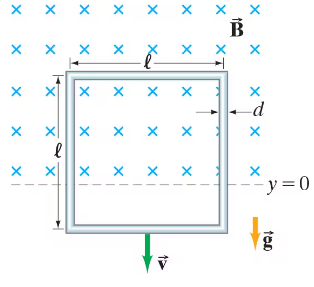
In a certain region of space near Earth’s surface, a uniform horizontal magnetic field of magnitude B exists above a level defined to be y = 0. Below y = 0, the field abruptly becomes zero (Fig. 29–63). A vertical square wire loop has resistivity ρ, mass density ρm, diameter d, and side length ℓ. It is initially at rest with its lower horizontal side at y = 0 and is then allowed to fall under gravity, with its plane perpendicular to the direction of the magnetic field. (a) While the loop is still partially immersed in the magnetic field (as it falls into the zero-field region), determine the magnetic “drag” force that acts on it at the moment when its speed is υ. (b) Assume that the loop achieves a constant terminal velocity VT before its upper horizontal side exits the field. Determine a formula for VT. (c) If the loop is made of copper and B = 0.80 T, find VT.

Guida verificata passo dopo passo
1
Step 1: Begin by analyzing the situation described in the problem. The wire loop is falling under gravity through a region with a uniform horizontal magnetic field above y = 0, and no magnetic field below y = 0. The loop experiences a magnetic drag force due to the induced current caused by its motion through the magnetic field. This force opposes the motion of the loop.
Step 2: To determine the magnetic drag force (part a), use Faraday's law of induction to calculate the induced electromotive force (EMF) in the loop. The EMF is given by \( \mathcal{E} = - \frac{d\Phi_B}{dt} \), where \( \Phi_B \) is the magnetic flux. The flux is \( \Phi_B = B \cdot A \), where \( A \) is the area of the loop in the magnetic field. As the loop falls, the area exposed to the field changes, leading to an EMF.
Step 3: The induced current \( I \) in the loop can be calculated using Ohm's law: \( I = \frac{\mathcal{E}}{R} \), where \( R \) is the resistance of the loop. The resistance is determined by the resistivity \( \rho \), the length of the wire \( L \), and its cross-sectional area \( A_c \): \( R = \frac{\rho L}{A_c} \). Substitute the values for \( L \) (the total length of the square loop) and \( A_c \) (based on the wire's diameter \( d \)).
Step 4: The magnetic drag force \( F_{drag} \) is given by \( F_{drag} = I \cdot \ell \cdot B \), where \( \ell \) is the length of the side of the loop in the magnetic field. Substitute the expression for \( I \) from Step 3 into this formula to find \( F_{drag} \) as a function of the loop's velocity \( \upsilon \).
Step 5: For part (b), at terminal velocity \( V_T \), the magnetic drag force balances the gravitational force acting on the loop. Set \( F_{drag} = F_{gravity} \), where \( F_{gravity} = P_m \cdot g \cdot \ell^2 \) (mass density times gravitational acceleration times the area of the loop). Solve for \( V_T \) using the expressions derived for \( F_{drag} \) and \( F_{gravity} \). For part (c), substitute the given values for copper's resistivity, \( B \), and other parameters into the formula for \( V_T \) to find its numerical value.

Risposta video verificata per un problema simile:

Questa soluzione video è stata consigliata dai nostri tutor come utile per risolvere questo problema.
Durata del video:
11m

Concetti chiave

Ecco i concetti essenziali che devi comprendere per rispondere correttamente alla domanda.

Magnetic Induction

Magnetic induction refers to the process by which a changing magnetic field within a closed loop induces an electromotive force (EMF) in the loop. This phenomenon is described by Faraday's Law of Electromagnetic Induction, which states that the induced EMF is proportional to the rate of change of magnetic flux through the loop. In the context of the falling wire loop, as it moves through the magnetic field, it experiences a change in magnetic flux, leading to the generation of an induced current.
Video consigliato:
Percorso guidato
12:59
Mutual Induction

Lorentz Force

The Lorentz force is the force experienced by a charged particle moving through a magnetic field. It is given by the equation F = q(v × B), where F is the force, q is the charge, v is the velocity of the particle, and B is the magnetic field. In the case of the wire loop, the induced current creates a magnetic field that interacts with the external magnetic field, resulting in a magnetic drag force that opposes the motion of the loop as it falls.
Video consigliato:
Percorso guidato
13:39
Lorentz Transformations of Velocity

Terminal Velocity

Terminal velocity is the constant speed that a freely falling object eventually reaches when the resistance of the medium through which it is falling prevents further acceleration. In this scenario, the loop will reach a terminal velocity when the magnetic drag force equals the gravitational force acting on it. This balance of forces allows for the derivation of a formula for terminal velocity, which can be calculated based on the properties of the loop and the magnetic field.
Video consigliato:
Percorso guidato
7:27
Escape Velocity
Pratica correlata
Domanda del libro di testo

What is the energy dissipated as a function of time in a circular loop of 18 turns of wire having a radius of 10.0 cm and a resistance of 2.0 Ω if the plane of the loop is perpendicular to a magnetic field given by B(t) = B₀e⁻ᵗ/ʳ with B₀ = 0.50 T and τ = 0.10 s?

1279
views
Domanda del libro di testo

Apply Faraday’s law, in the form of Eq. 29–8, to show that the static electric field between the plates of a parallel-plate capacitor cannot drop abruptly to zero at the edges, but must, in fact, fringe. Use the path shown dashed in Fig. 29–61. [Hint: Assume the contrary: that there is no fringing. Show that this assumption leads to a contradiction.]

1371
views
Domanda del libro di testo

In an experiment, a coil was mounted on a low-friction cart that moved through the magnetic field B of a permanent magnet. The speed of the cart v and the induced voltage V were simultaneously measured, as the cart moved through the magnetic field, using a computer-interfaced motion sensor and a voltmeter. The Table below shows the collected data:

Make a graph of the induced voltage, V, vs. the speed, v. Determine a best-fit linear equation for the data. Theoretically, the relationship between V and v is given by V = BN𝓁𝓋 where N is the number of turns of the coil, B is the magnetic field, and ℓ is the average of the inside and outside widths of the coil. In the experiment, B = 0.126 T, N = 50, and ℓ = 0.0561 m.

75
views
Domanda del libro di testo

Determine the magnetic field at a point P due to a very long wire with a square bend as shown in Fig. 28–63. The point P is halfway between the two corners.

710
views
Domanda del libro di testo

In an experiment, a coil was mounted on a low-friction cart that moved through the magnetic field B of a permanent magnet. The speed of the cart v and the induced voltage V were simultaneously measured, as the cart moved through the magnetic field, using a computer-interfaced motion sensor and a voltmeter. The Table below shows the collected data:

Find the % error between the slope of the experimental graph and the theoretical value for the slope.

1544
views