Ch. 30 - Inductance, Electromagnetic Oscillations, and AC Circuits
Giancoli Douglas - Physics for Scientists and Engineers 5th edition
Giancoli Douglas5th editionPhysics for Scientists and EngineersISBN: 9780137488179Non è quello che usi tu?Cambia libro di testo
Capitolo 29, Problema 10

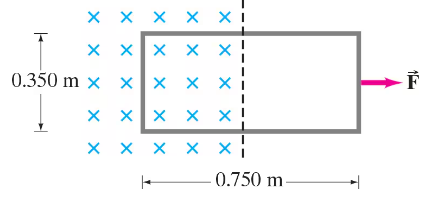
(II) Part of a single rectangular loop of wire with dimensions shown in Fig. 29–49 is situated inside a region of uniform magnetic field of 0.650 T. The total resistance of the loop is 0.250 Ω. Calculate the force required to pull the loop from the field (to the right) at a constant velocity of 3.40 m/s. Neglect gravity.

Guida verificata passo dopo passo
1
Step 1: Understand the problem. The wire loop is partially inside a uniform magnetic field, and we need to calculate the force required to pull the loop out of the field at a constant velocity. This involves electromagnetic induction, where a changing magnetic flux induces an electromotive force (EMF) and a current in the loop.
Step 2: Calculate the induced EMF using Faraday's Law of Induction. The EMF (ε) is given by the formula: ε=Blv, where B is the magnetic field strength (0.650 T), l is the length of the wire in the field, and v is the velocity of the loop (3.40 m/s).
Step 3: Determine the current in the loop using Ohm's Law. The current I is given by: I=εR, where R is the resistance of the loop (0.250 Ω). Substitute the value of ε from Step 2 into this formula.
Step 4: Calculate the magnetic force acting on the wire. The force F is given by: F=IlB, where I is the current (from Step 3), l is the length of the wire in the field, and B is the magnetic field strength.
Step 5: Interpret the result. The force calculated in Step 4 is the force required to pull the loop out of the magnetic field at a constant velocity. This force counteracts the magnetic force due to the induced current in the loop.

Risposta video verificata per un problema simile:

Questa soluzione video è stata consigliata dai nostri tutor come utile per risolvere questo problema.
Durata del video:
7m

Concetti chiave

Ecco i concetti essenziali che devi comprendere per rispondere correttamente alla domanda.

Electromagnetic Induction

Electromagnetic induction is the process by which a changing magnetic field within a closed loop induces an electromotive force (EMF) in the wire. This phenomenon is described by Faraday's Law, which states that the induced EMF is proportional to the rate of change of magnetic flux through the loop. In this scenario, as the loop is pulled out of the magnetic field, the change in magnetic flux induces a current in the loop.
Video consigliato:
Percorso guidato
05:42
Introduction to Induction

Lorentz Force

The Lorentz force is the force experienced by a charged particle moving through a magnetic field. It is given by the equation F = q(v × B), where F is the force, q is the charge, v is the velocity of the particle, and B is the magnetic field. In the context of the loop, the induced current creates a magnetic field that interacts with the external magnetic field, resulting in a force that opposes the motion of the loop, known as Lenz's Law.
Video consigliato:
Percorso guidato
13:39
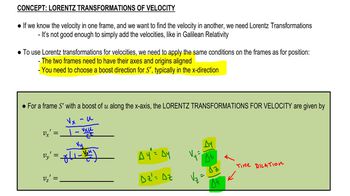
Lorentz Transformations of Velocity

Ohm's Law

Ohm's Law relates the voltage (V), current (I), and resistance (R) in an electrical circuit, expressed as V = IR. In this problem, the induced EMF in the loop causes a current to flow, which can be calculated using the total resistance of the loop. Understanding Ohm's Law is essential for determining the current generated by the induced EMF, which in turn affects the force required to pull the loop from the magnetic field.
Video consigliato:
Percorso guidato
03:07
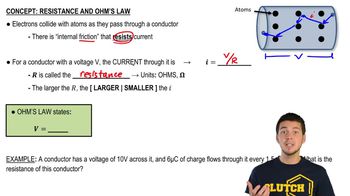
Resistance and Ohm's Law
Pratica correlata
Domanda del libro di testo

(II) If the solenoid in Fig. 29–47 is being pulled away from the loop shown, in what direction is the induced current in the loop? Explain.

1391
views

Domanda del libro di testo

(III) A toroid has a rectangular cross section as shown in Fig. 30–26. Show that the self-inductance is


L=μ0N2h2πlnr2r1L = \(\frac{\mu_0 N^2 h}{2\pi}\) \(\ln\) \(\frac{r_2}{r_1}\)


where N is the total number of turns and r₁, r₂ and h are the dimensions shown in Fig. 30–26. [Hint: Use Ampère’s law to get B as a function of r inside the toroid, and integrate.]


1606
views
Domanda del libro di testo

A coil has 3.25-Ω resistance and 440-mH inductance. If the current is 3.00 A and is increasing at a rate of 3.15 A/s, what is the potential difference across the coil at this moment?

1841
views
Domanda del libro di testo

What is the energy density at the center of a circular loop of wire carrying a 19.0-A current if the radius of the loop is 28.0 cm?

155
views
Domanda del libro di testo

(III) A long straight wire and a small rectangular wire loop lie in the same plane, Fig. 30–25. Determine the mutual inductance in terms of 𝓁₁, 𝓁₂, and w. Assume the wire is very long compared to 𝓁₁, 𝓁₂, and w, and that the rest of its circuit is very far away compared to 𝓁₁, 𝓁₂, and w.

1349
views
Domanda del libro di testo

The magnetic field inside an air-filled solenoid 38.0 cm long and 2.10 cm in diameter is 0.720 T. Approximately how much energy is stored in this field?

123
views