
Ch. 31 - Maxwell's Equations and Electromagnetic Waves
Giancoli Douglas - Physics for Scientists and Engineers 5th edition
Giancoli Douglas5th editionPhysics for Scientists and EngineersISBN: 9780137488179Non è quello che usi tu?Cambia libro di testo
Capitolo 30, Problema 54

Radio-controlled clocks throughout the United States receive a radio signal from a transmitter in Fort Collins, Colorado, that accurately (within a microsecond) marks the beginning of each minute. A slight amount of time is added by a clock at any location to correct for the signal travel time to the clock from Fort Collins. Assuming Fort Collins is no more than 3000 km from any point in the U.S., what is the longest travel-time delay?

Guida verificata passo dopo passo
1
Determine the speed of the radio signal. Since radio signals are electromagnetic waves, they travel at the speed of light in a vacuum, which is approximately 3 × 10⁸ m/s.
Convert the maximum distance from Fort Collins to any point in the U.S. into meters. Given that the maximum distance is 3000 km, convert it to meters using the conversion factor: 1 km = 1000 m. Thus, 3000 km = 3000 × 1000 = 3 × 10⁶ m.
Use the formula for time delay: t=dv, where t is the travel time, d is the distance, and v is the speed of the signal. Substitute d=3×10⁶ m and v=3×10⁸ m/s into the formula.
Simplify the expression to calculate the time delay: t=3×10⁶3×10⁸. This will give the time delay in seconds.
Interpret the result. The calculated time delay represents the longest travel-time delay for the radio signal to reach any point in the U.S. from Fort Collins, Colorado.

Risposta video verificata per un problema simile:

Questa soluzione video è stata consigliata dai nostri tutor come utile per risolvere questo problema.
Durata del video:
5m

Concetti chiave

Ecco i concetti essenziali che devi comprendere per rispondere correttamente alla domanda.

Speed of Light

The speed of light in a vacuum is approximately 299,792 kilometers per second. This fundamental constant is crucial for understanding how quickly signals, such as radio waves, travel. Since radio signals travel at the speed of light, knowing this speed allows us to calculate the time it takes for a signal to reach a receiver from a transmitter.
Video consigliato:
Percorso guidato
06:03
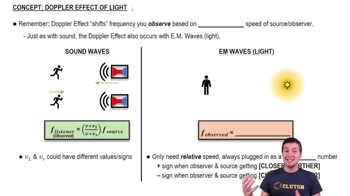
The Doppler Effect (Light)

Time Delay Calculation

Time delay refers to the duration it takes for a signal to travel from one point to another. To calculate the time delay for a radio signal traveling a distance of 3000 km, one can use the formula: time = distance/speed. This calculation is essential for determining how much time should be added to a clock to account for the signal's travel time.
Video consigliato:
Percorso guidato
04:43
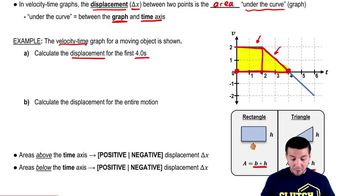
Calculating Displacement from Velocity-Time Graphs

Signal Propagation

Signal propagation is the way in which radio waves travel through space. Factors such as distance, medium, and environmental conditions can affect the speed and quality of the signal. Understanding signal propagation is important for accurately determining the effective range and timing of radio-controlled devices, such as clocks.
Video consigliato:
Pratica correlata
Domanda del libro di testo

A global positioning system (GPS) functions by determining the travel times for EM waves from various satellites to a moving GPS receiver on Earth (car or hiker). If the receiver is to detect a change in the receiver’s position on the order of 3 m, what is the associated change in travel time (in ns) that must be measured?

3
views
Domanda del libro di testo

What length of antenna would be appropriate for a portable device that could receive satellite TV?

57
views
Domanda del libro di testo

Who will hear the voice of a singer first: a person in the balcony 50.0 km away from the stage (see Fig. 31–26), or a person 1800 km away at home whose ear is next to the radio listening to a live broadcast? Roughly how much sooner? Assume the microphone is a few centimeters from the singer and the temperature is 20℃.


<IMAGE>

1329
views
Domanda del libro di testo

A powerful laser portrayed in a movie provides a 3-mm-diameter beam of green light with a power of 3 W. A good agent inside a spacecraft aims the laser beam at an enemy astronaut hovering outside. The mass of the enemy astronaut is 120 kg and the spacecraft 185,000 kg. (a) Determine the “radiation-pressure” force exerted on the enemy by the laser beam assuming her suit is perfectly reflecting. (b) If the enemy is 30 m from the spacecraft’s center of mass, estimate the gravitational force the spacecraft exerts on the enemy. (c) Which of the two forces is larger, and by what factor?

1866
views
Domanda del libro di testo

The average intensity of a particular TV station’s signal is 1.0 x 10⁻¹³ W/m2 when it arrives at a 33-cm-diameter satellite TV antenna. (a) Calculate the total energy received by the antenna during 3.0 hours of viewing this station’s programs. (b) Estimate the amplitudes of the E and B fields of the EM wave.

57
views
Domanda del libro di testo

A satellite beams microwave radiation with a power of 16 kW toward the Earth’s surface, 550 km away. When the beam strikes Earth, its circular diameter is about 1500 m. Find the rms electric field strength of the beam.

3
views